


Description
You are given a 0-indexed integer array nums of length n.
A split at an index i where 0 <= i <= n - 2 is called valid if the product of the first i + 1 elements and the product of the remaining elements are coprime.
- For example, if
nums = [2, 3, 3], then a split at the indexi = 0is valid because2and9are coprime, while a split at the indexi = 1is not valid because6and3are not coprime. A split at the indexi = 2is not valid becausei == n - 1.
Return the smallest index i at which the array can be split validly or -1 if there is no such split.
Two values val1 and val2 are coprime if gcd(val1, val2) == 1 where gcd(val1, val2) is the greatest common divisor of val1 and val2.
Example 1:
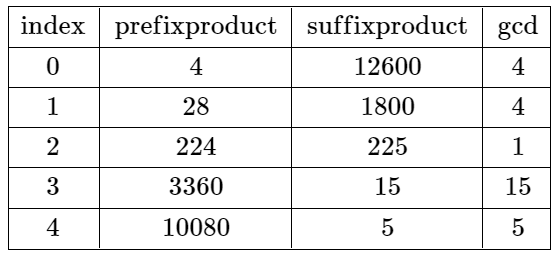
Input: nums = [4,7,8,15,3,5]
Output: 2
Explanation: The table above shows the values of the product of the first i + 1 elements, the remaining elements, and their gcd at each index i.
The only valid split is at index 2.
Example 2:
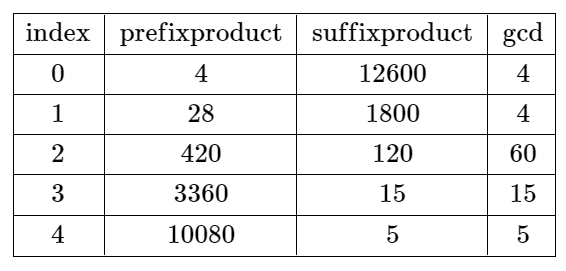
Input: nums = [4,7,15,8,3,5]
Output: -1
Explanation: The table above shows the values of the product of the first i + 1 elements, the remaining elements, and their gcd at each index i.
There is no valid split.
Constraints:
n == nums.length1 <= n <= 1041 <= nums[i] <= 106
Solutions
Solution 1
PythonJavaC++Go
class Solution: def findValidSplit(self, nums: List[int]) -> int: first = {} n = len(nums) last = list(range(n)) for i, x in enumerate(nums): j = 2 while j <= x // j: if x % j == 0: if j in first: last[first[j]] = i else: first[j] = i while x % j == 0: x //= j j += 1 if x > 1: if x in first: last[first[x]] = i else: first[x] = i mx = last[0] for i, x in enumerate(last): if mx < i: return mx mx = max(mx, x) return -1(code-box)
