


Description
Alice has an undirected tree with n nodes labeled from 0 to n - 1. The tree is represented as a 2D integer array edges of length n - 1 where edges[i] = [ai, bi] indicates that there is an edge between nodes ai and bi in the tree.
Alice wants Bob to find the root of the tree. She allows Bob to make several guesses about her tree. In one guess, he does the following:
- Chooses two distinct integers
uandvsuch that there exists an edge[u, v]in the tree. - He tells Alice that
uis the parent ofvin the tree.
Bob's guesses are represented by a 2D integer array guesses where guesses[j] = [uj, vj] indicates Bob guessed uj to be the parent of vj.
Alice being lazy, does not reply to each of Bob's guesses, but just says that at least k of his guesses are true.
Given the 2D integer arrays edges, guesses and the integer k, return the number of possible nodes that can be the root of Alice's tree. If there is no such tree, return 0.
Example 1:
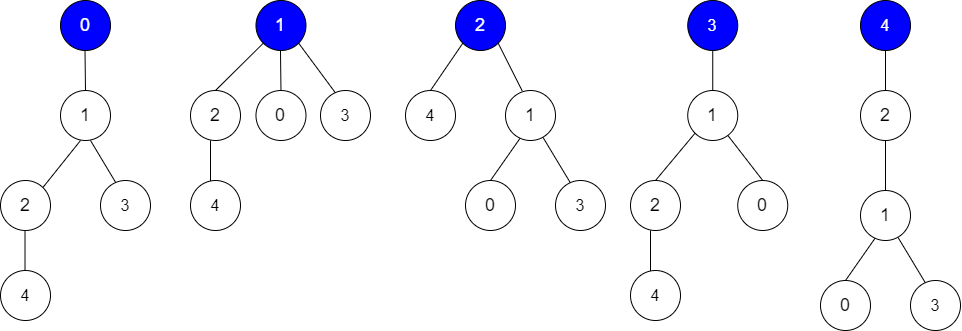
Input: edges = [[0,1],[1,2],[1,3],[4,2]], guesses = [[1,3],[0,1],[1,0],[2,4]], k = 3
Output: 3
Explanation:
Root = 0, correct guesses = [1,3], [0,1], [2,4]
Root = 1, correct guesses = [1,3], [1,0], [2,4]
Root = 2, correct guesses = [1,3], [1,0], [2,4]
Root = 3, correct guesses = [1,0], [2,4]
Root = 4, correct guesses = [1,3], [1,0]
Considering 0, 1, or 2 as root node leads to 3 correct guesses.
Example 2:
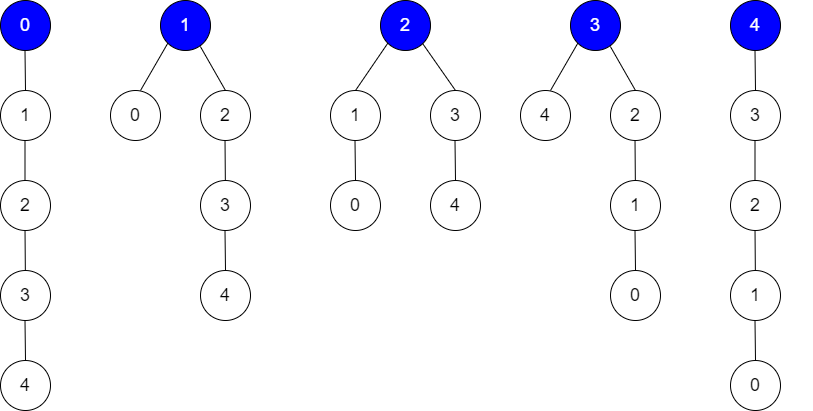
Input: edges = [[0,1],[1,2],[2,3],[3,4]], guesses = [[1,0],[3,4],[2,1],[3,2]], k = 1
Output: 5
Explanation:
Root = 0, correct guesses = [3,4]
Root = 1, correct guesses = [1,0], [3,4]
Root = 2, correct guesses = [1,0], [2,1], [3,4]
Root = 3, correct guesses = [1,0], [2,1], [3,2], [3,4]
Root = 4, correct guesses = [1,0], [2,1], [3,2]
Considering any node as root will give at least 1 correct guess.
Constraints:
edges.length == n - 12 <= n <= 1051 <= guesses.length <= 1050 <= ai, bi, uj, vj <= n - 1ai != biuj != vjedgesrepresents a valid tree.guesses[j]is an edge of the tree.guessesis unique.0 <= k <= guesses.length
Solutions
Solution 1: Tree DP (change root)
First, we traverse the given edge set edges and convert it to an adjacency list g where g[i] represents the adjacent nodes of node i. Use a hash map gs to record the given guess set guesses.
Then, we start from node 0 and perform a DFS to count the number of edges in guesses among all the nodes that can be reached from node 0. We use the variable cnt to record this number.
Next, we start from node 0 and perform a DFS to count the number of edges in guesses in each tree with 0 as the root. If the number is greater than or equal to k, it means that this node is a possible root node, and we add 1 to the answer.
Therefore, the problem becomes to count the number of edges in guesses in each tree with each node as the root. We already know that there are cnt edges in guesses among all the nodes that can be reached from node 0. We can maintain this value by adding or subtracting the current edge in guesses in DFS.
Assume that we are currently traversing node i and cnt represents the number of edges in guesses with i as the root node. Then, for each adjacent node j of i, we need to calculate the number of edges in guesses with j as the root node. If (i, j) is in guesses, then there is no edge (i, j) in the tree with j as the root node, so cnt should decrease by 1. If (j, i) is in guesses, then there is an extra edge (i, j) in the tree with j as the root node, so cnt should increase by 1. That is, f[j] = f[i] + (j, i) ∈ guesses - (i, j) ∈ guesses. Where f[i] represents the number of edges in guesses with i as the root node.
The time complexity is O(n + m) and the space complexity is O(n + m), where n and m are the lengths of edges and guesses respectively.
class Solution: def rootCount( self, edges: List[List[int]], guesses: List[List[int]], k: int ) -> int: def dfs1(i, fa): nonlocal cnt for j in g[i]: if j != fa: cnt += gs[(i, j)] dfs1(j, i) def dfs2(i, fa): nonlocal ans, cnt ans += cnt >= k for j in g[i]: if j != fa: cnt -= gs[(i, j)] cnt += gs[(j, i)] dfs2(j, i) cnt -= gs[(j, i)] cnt += gs[(i, j)] g = defaultdict(list) for a, b in edges: g[a].append(b) g[b].append(a) gs = Counter((u, v) for u, v in guesses) cnt = 0 dfs1(0, -1) ans = 0 dfs2(0, -1) return ans(code-box)
