


Description
You are given a 0-indexed m x n binary matrix grid. You can move from a cell (row, col) to any of the cells (row + 1, col) or (row, col + 1).
Return true if there is a path from (0, 0) to (m - 1, n - 1) that visits an equal number of 0's and 1's. Otherwise return false.
Example 1:
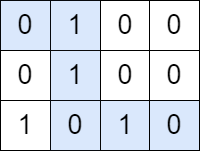
Input: grid = [[0,1,0,0],[0,1,0,0],[1,0,1,0]]
Output: true
Explanation: The path colored in blue in the above diagram is a valid path because we have 3 cells with a value of 1 and 3 with a value of 0. Since there is a valid path, we return true.
Example 2:
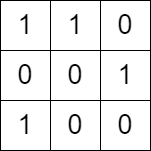
Input: grid = [[1,1,0],[0,0,1],[1,0,0]]
Output: false
Explanation: There is no path in this grid with an equal number of 0's and 1's.
Constraints:
m == grid.lengthn == grid[i].length2 <= m, n <= 100grid[i][j]is either0or1.
Solutions
Solution 1: Memoization Search
According to the problem description, we know that the number of 0s and 1s on the path from the top-left corner to the bottom-right corner is equal, and the total number is m + n - 1, which means the number of 0s and 1s are both (m + n - 1) / 2.
Therefore, we can use memoization search, starting from the top-left corner and moving right or down until reaching the bottom-right corner, to check if the number of 0s and 1s on the path is equal.
The time complexity is O(m × n × (m + n)). Here, m and n are the number of rows and columns of the matrix, respectively.
class Solution: def isThereAPath(self, grid: List[List[int]]) -> bool: @cache def dfs(i, j, k): if i >= m or j >= n: return False k += grid[i][j] if k > s or i + j + 1 - k > s: return False if i == m - 1 and j == n - 1: return k == s return dfs(i + 1, j, k) or dfs(i, j + 1, k) m, n = len(grid), len(grid[0]) s = m + n - 1 if s & 1: return False s >>= 1 return dfs(0, 0, 0)(code-box)
