


Description
You are given an m x n integer matrix grid.
We define an hourglass as a part of the matrix with the following form:
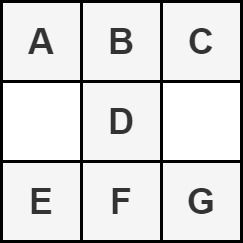
Return the maximum sum of the elements of an hourglass.
Note that an hourglass cannot be rotated and must be entirely contained within the matrix.
Example 1:
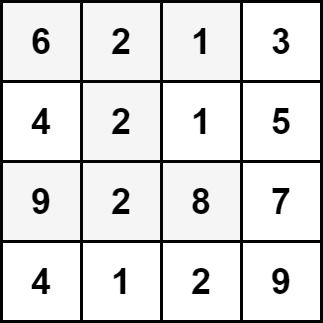
Input: grid = [[6,2,1,3],[4,2,1,5],[9,2,8,7],[4,1,2,9]]
Output: 30
Explanation: The cells shown above represent the hourglass with the maximum sum: 6 + 2 + 1 + 2 + 9 + 2 + 8 = 30.
Example 2:
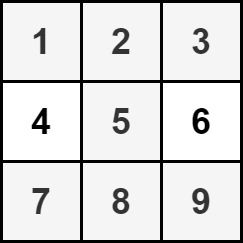
Input: grid = [[1,2,3],[4,5,6],[7,8,9]]
Output: 35
Explanation: There is only one hourglass in the matrix, with the sum: 1 + 2 + 3 + 5 + 7 + 8 + 9 = 35.
Constraints:
m == grid.lengthn == grid[i].length3 <= m, n <= 1500 <= grid[i][j] <= 106
Solutions
Solution 1: Enumeration
We observe from the problem statement that each hourglass is a 3 × 3 matrix with the first and last elements of the middle row removed. Therefore, we can start from the top left corner, enumerate the middle coordinate (i, j) of each hourglass, then calculate the sum of the elements in the hourglass, and take the maximum value.
The time complexity is O(m × n), where m and n are the number of rows and columns of the matrix, respectively. The space complexity is O(1).
class Solution: def maxSum(self, grid: List[List[int]]) -> int: m, n = len(grid), len(grid[0]) ans = 0 for i in range(1, m - 1): for j in range(1, n - 1): s = -grid[i][j - 1] - grid[i][j + 1] s += sum( grid[x][y] for x in range(i - 1, i + 2) for y in range(j - 1, j + 2) ) ans = max(ans, s) return ans(code-box)
