
Description
You are given the root of a binary tree with unique values, and an integer start. At minute 0, an infection starts from the node with value start.
Each minute, a node becomes infected if:
- The node is currently uninfected.
- The node is adjacent to an infected node.
Return the number of minutes needed for the entire tree to be infected.
Example 1:
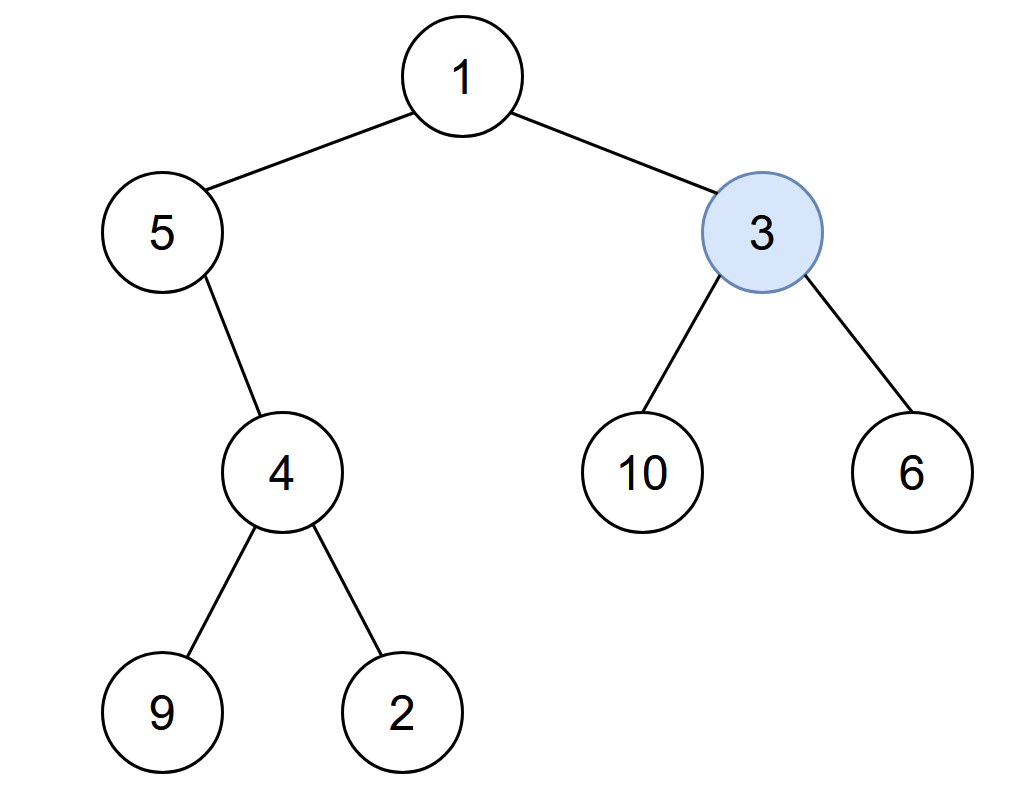
Input: root = [1,5,3,null,4,10,6,9,2], start = 3
Output: 4
Explanation: The following nodes are infected during:
- Minute 0: Node 3
- Minute 1: Nodes 1, 10 and 6
- Minute 2: Node 5
- Minute 3: Node 4
- Minute 4: Nodes 9 and 2
It takes 4 minutes for the whole tree to be infected so we return 4.
Example 2:
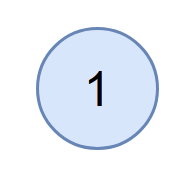
Input: root = [1], start = 1
Output: 0
Explanation: At minute 0, the only node in the tree is infected so we return 0.
Constraints:
- The number of nodes in the tree is in the range
[1, 105].
1 <= Node.val <= 105- Each node has a unique value.
- A node with a value of
start exists in the tree.
Solutions
Solution 1: Two DFS
First, we build a graph through one DFS, and get an adjacency list g, where g[node] represents all nodes connected to the node node.
Then, we use start as the starting point, and search the entire tree through DFS to find the farthest distance, which is the answer.
The time complexity is O(n), and the space complexity is O(n), where n is the number of nodes in the binary tree.
PythonJavaC++GoTypeScript
# Definition for a binary tree node.
# class TreeNode:
# def __init__(self, val=0, left=None, right=None):
# self.val = val
# self.left = left
# self.right = right
class Solution:
def amountOfTime(self, root: Optional[TreeNode], start: int) -> int:
def dfs(node: Optional[TreeNode], fa: Optional[TreeNode]):
if node is None:
return
if fa:
g[node.val].append(fa.val)
g[fa.val].append(node.val)
dfs(node.left, node)
dfs(node.right, node)
def dfs2(node: int, fa: int) -> int:
ans = 0
for nxt in g[node]:
if nxt != fa:
ans = max(ans, 1 + dfs2(nxt, node))
return ans
g = defaultdict(list)
dfs(root, None)
return dfs2(start, -1)(code-box)
/**
* Definition for a binary tree node.
* public class TreeNode {
* int val;
* TreeNode left;
* TreeNode right;
* TreeNode() {}
* TreeNode(int val) { this.val = val; }
* TreeNode(int val, TreeNode left, TreeNode right) {
* this.val = val;
* this.left = left;
* this.right = right;
* }
* }
*/
class Solution {
private Map<Integer, List<Integer>> g = new HashMap<>();
public int amountOfTime(TreeNode root, int start) {
dfs(root, null);
return dfs2(start, -1);
}
private void dfs(TreeNode node, TreeNode fa) {
if (node == null) {
return;
}
if (fa != null) {
g.computeIfAbsent(node.val, k -> new ArrayList<>()).add(fa.val);
g.computeIfAbsent(fa.val, k -> new ArrayList<>()).add(node.val);
}
dfs(node.left, node);
dfs(node.right, node);
}
private int dfs2(int node, int fa) {
int ans = 0;
for (int nxt : g.getOrDefault(node, List.of())) {
if (nxt != fa) {
ans = Math.max(ans, 1 + dfs2(nxt, node));
}
}
return ans;
}
}(code-box)
/**
* Definition for a binary tree node.
* struct TreeNode {
* int val;
* TreeNode *left;
* TreeNode *right;
* TreeNode() : val(0), left(nullptr), right(nullptr) {}
* TreeNode(int x) : val(x), left(nullptr), right(nullptr) {}
* TreeNode(int x, TreeNode *left, TreeNode *right) : val(x), left(left), right(right) {}
* };
*/
class Solution {
public:
int amountOfTime(TreeNode* root, int start) {
unordered_map<int, vector<int>> g;
function<void(TreeNode*, TreeNode*)> dfs = [&](TreeNode* node, TreeNode* fa) {
if (!node) {
return;
}
if (fa) {
g[node->val].push_back(fa->val);
g[fa->val].push_back(node->val);
}
dfs(node->left, node);
dfs(node->right, node);
};
function<int(int, int)> dfs2 = [&](int node, int fa) -> int {
int ans = 0;
for (int nxt : g[node]) {
if (nxt != fa) {
ans = max(ans, 1 + dfs2(nxt, node));
}
}
return ans;
};
dfs(root, nullptr);
return dfs2(start, -1);
}
};(code-box)
/**
* Definition for a binary tree node.
* type TreeNode struct {
* Val int
* Left *TreeNode
* Right *TreeNode
* }
*/
func amountOfTime(root *TreeNode, start int) int {
g := map[int][]int{}
var dfs func(*TreeNode, *TreeNode)
dfs = func(node, fa *TreeNode) {
if node == nil {
return
}
if fa != nil {
g[node.Val] = append(g[node.Val], fa.Val)
g[fa.Val] = append(g[fa.Val], node.Val)
}
dfs(node.Left, node)
dfs(node.Right, node)
}
var dfs2 func(int, int) int
dfs2 = func(node, fa int) (ans int) {
for _, nxt := range g[node] {
if nxt != fa {
ans = max(ans, 1+dfs2(nxt, node))
}
}
return
}
dfs(root, nil)
return dfs2(start, -1)
}(code-box)
/**
* Definition for a binary tree node.
* class TreeNode {
* val: number
* left: TreeNode | null
* right: TreeNode | null
* constructor(val?: number, left?: TreeNode | null, right?: TreeNode | null) {
* this.val = (val===undefined ? 0 : val)
* this.left = (left===undefined ? null : left)
* this.right = (right===undefined ? null : right)
* }
* }
*/
function amountOfTime(root: TreeNode | null, start: number): number {
const g: Map<number, number[]> = new Map();
const dfs = (node: TreeNode | null, fa: TreeNode | null) => {
if (!node) {
return;
}
if (fa) {
if (!g.has(node.val)) {
g.set(node.val, []);
}
g.get(node.val)!.push(fa.val);
if (!g.has(fa.val)) {
g.set(fa.val, []);
}
g.get(fa.val)!.push(node.val);
}
dfs(node.left, node);
dfs(node.right, node);
};
const dfs2 = (node: number, fa: number): number => {
let ans = 0;
for (const nxt of g.get(node) || []) {
if (nxt !== fa) {
ans = Math.max(ans, 1 + dfs2(nxt, node));
}
}
return ans;
};
dfs(root, null);
return dfs2(start, -1);
}(code-box)


