
Description
There is an undirected connected tree with n nodes labeled from 0 to n - 1 and n - 1 edges.
You are given a 0-indexed integer array nums of length n where nums[i] represents the value of the ith node. You are also given a 2D integer array edges of length n - 1 where edges[i] = [ai, bi] indicates that there is an edge between nodes ai and bi in the tree.
Remove two distinct edges of the tree to form three connected components. For a pair of removed edges, the following steps are defined:
- Get the XOR of all the values of the nodes for each of the three components respectively.
- The difference between the largest XOR value and the smallest XOR value is the score of the pair.
- For example, say the three components have the node values:
[4,5,7], [1,9], and [3,3,3]. The three XOR values are 4 ^ 5 ^ 7 = 6, 1 ^ 9 = 8, and 3 ^ 3 ^ 3 = 3. The largest XOR value is 8 and the smallest XOR value is 3. The score is then 8 - 3 = 5.
Return the minimum score of any possible pair of edge removals on the given tree.
Example 1:
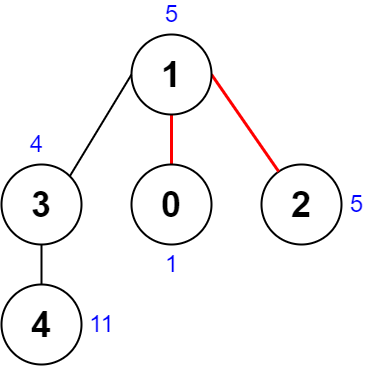
Input: nums = [1,5,5,4,11], edges = [[0,1],[1,2],[1,3],[3,4]]
Output: 9
Explanation: The diagram above shows a way to make a pair of removals.
- The 1st component has nodes [1,3,4] with values [5,4,11]. Its XOR value is 5 ^ 4 ^ 11 = 10.
- The 2nd component has node [0] with value [1]. Its XOR value is 1 = 1.
- The 3rd component has node [2] with value [5]. Its XOR value is 5 = 5.
The score is the difference between the largest and smallest XOR value which is 10 - 1 = 9.
It can be shown that no other pair of removals will obtain a smaller score than 9.
Example 2:
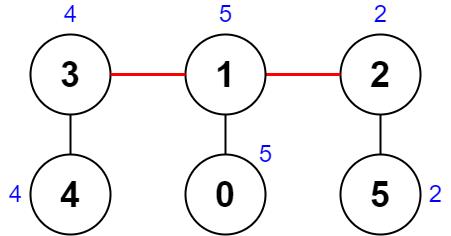
Input: nums = [5,5,2,4,4,2], edges = [[0,1],[1,2],[5,2],[4,3],[1,3]]
Output: 0
Explanation: The diagram above shows a way to make a pair of removals.
- The 1st component has nodes [3,4] with values [4,4]. Its XOR value is 4 ^ 4 = 0.
- The 2nd component has nodes [1,0] with values [5,5]. Its XOR value is 5 ^ 5 = 0.
- The 3rd component has nodes [2,5] with values [2,2]. Its XOR value is 2 ^ 2 = 0.
The score is the difference between the largest and smallest XOR value which is 0 - 0 = 0.
We cannot obtain a smaller score than 0.
Constraints:
n == nums.length3 <= n <= 10001 <= nums[i] <= 108edges.length == n - 1edges[i].length == 20 <= ai, bi < nai != biedges represents a valid tree.
Solutions
Solution 1: DFS + Subtree XOR Sum
We denote the XOR sum of the tree as s, i.e., s = nums[0] \oplus nums[1] \oplus … \oplus nums[n-1].
Next, we enumerate each node i in [0..n) as the root of the tree, and treat the edge connecting the root node to some child node j as the first edge to be removed. This gives us two connected components. We denote the XOR sum of the connected component containing root node i as s1, then we perform DFS on the connected component containing root node i to calculate the XOR sum of each subtree, denoting each XOR sum calculated by DFS as s2. The XOR sums of the three connected components are s \oplus s1, s2, and s1 \oplus s2. We need to calculate the maximum and minimum values of these three XOR sums, denoted as mx and mn. For each enumerated case, the score is mx - mn. We find the minimum value among all cases as the answer.
The XOR sum of each subtree can be calculated through DFS. We define a function dfs(i, fa), which represents starting DFS from node i, where fa is the parent node of node i. The function returns the XOR sum of the subtree rooted at node i.
The time complexity is O(n2), and the space complexity is O(n), where n is the number of nodes in the tree.
PythonJavaC++GoTypeScriptRustC#
class Solution:
def minimumScore(self, nums: List[int], edges: List[List[int]]) -> int:
def dfs(i: int, fa: int) -> int:
res = nums[i]
for j in g[i]:
if j != fa:
res ^= dfs(j, i)
return res
def dfs2(i: int, fa: int) -> int:
nonlocal s, s1, ans
res = nums[i]
for j in g[i]:
if j != fa:
s2 = dfs2(j, i)
res ^= s2
mx = max(s ^ s1, s2, s1 ^ s2)
mn = min(s ^ s1, s2, s1 ^ s2)
ans = min(ans, mx - mn)
return res
g = defaultdict(list)
for a, b in edges:
g[a].append(b)
g[b].append(a)
s = reduce(lambda x, y: x ^ y, nums)
n = len(nums)
ans = inf
for i in range(n):
for j in g[i]:
s1 = dfs(i, j)
dfs2(i, j)
return ans(code-box)
class Solution {
private int[] nums;
private List<Integer>[] g;
private int ans = Integer.MAX_VALUE;
private int s;
private int s1;
public int minimumScore(int[] nums, int[][] edges) {
int n = nums.length;
this.nums = nums;
g = new List[n];
Arrays.setAll(g, k -> new ArrayList<>());
for (int[] e : edges) {
int a = e[0], b = e[1];
g[a].add(b);
g[b].add(a);
}
for (int x : nums) {
s ^= x;
}
for (int i = 0; i < n; ++i) {
for (int j : g[i]) {
s1 = dfs(i, j);
dfs2(i, j);
}
}
return ans;
}
private int dfs(int i, int fa) {
int res = nums[i];
for (int j : g[i]) {
if (j != fa) {
res ^= dfs(j, i);
}
}
return res;
}
private int dfs2(int i, int fa) {
int res = nums[i];
for (int j : g[i]) {
if (j != fa) {
int s2 = dfs2(j, i);
res ^= s2;
int mx = Math.max(Math.max(s ^ s1, s2), s1 ^ s2);
int mn = Math.min(Math.min(s ^ s1, s2), s1 ^ s2);
ans = Math.min(ans, mx - mn);
}
}
return res;
}
}(code-box)
class Solution {
public:
int minimumScore(vector<int>& nums, vector<vector<int>>& edges) {
int n = nums.size();
vector<int> g[n];
for (const auto& e : edges) {
int a = e[0], b = e[1];
g[a].push_back(b);
g[b].push_back(a);
}
int s = 0, s1 = 0;
int ans = INT_MAX;
for (int x : nums) {
s ^= x;
}
auto dfs = [&](this auto&& dfs, int i, int fa) -> int {
int res = nums[i];
for (int j : g[i]) {
if (j != fa) {
res ^= dfs(j, i);
}
}
return res;
};
auto dfs2 = [&](this auto&& dfs2, int i, int fa) -> int {
int res = nums[i];
for (int j : g[i]) {
if (j != fa) {
int s2 = dfs2(j, i);
res ^= s2;
int mx = max({s ^ s1, s2, s1 ^ s2});
int mn = min({s ^ s1, s2, s1 ^ s2});
ans = min(ans, mx - mn);
}
}
return res;
};
for (int i = 0; i < n; ++i) {
for (int j : g[i]) {
s1 = dfs(i, j);
dfs2(i, j);
}
}
return ans;
}
};(code-box)
func minimumScore(nums []int, edges [][]int) int {
n := len(nums)
g := make([][]int, n)
for _, e := range edges {
a, b := e[0], e[1]
g[a] = append(g[a], b)
g[b] = append(g[b], a)
}
s, s1 := 0, 0
ans := math.MaxInt32
for _, x := range nums {
s ^= x
}
var dfs func(i, fa int) int
dfs = func(i, fa int) int {
res := nums[i]
for _, j := range g[i] {
if j != fa {
res ^= dfs(j, i)
}
}
return res
}
var dfs2 func(i, fa int) int
dfs2 = func(i, fa int) int {
res := nums[i]
for _, j := range g[i] {
if j != fa {
s2 := dfs2(j, i)
res ^= s2
mx := max(s^s1, s2, s1^s2)
mn := min(s^s1, s2, s1^s2)
ans = min(ans, mx-mn)
}
}
return res
}
for i := 0; i < n; i++ {
for _, j := range g[i] {
s1 = dfs(i, j)
dfs2(i, j)
}
}
return ans
}(code-box)
function minimumScore(nums: number[], edges: number[][]): number {
const n = nums.length;
const g: number[][] = Array.from({ length: n }, () => []);
for (const [a, b] of edges) {
g[a].push(b);
g[b].push(a);
}
const s = nums.reduce((a, b) => a ^ b, 0);
let s1 = 0;
let ans = Number.MAX_SAFE_INTEGER;
function dfs(i: number, fa: number): number {
let res = nums[i];
for (const j of g[i]) {
if (j !== fa) {
res ^= dfs(j, i);
}
}
return res;
}
function dfs2(i: number, fa: number): number {
let res = nums[i];
for (const j of g[i]) {
if (j !== fa) {
const s2 = dfs2(j, i);
res ^= s2;
const mx = Math.max(s ^ s1, s2, s1 ^ s2);
const mn = Math.min(s ^ s1, s2, s1 ^ s2);
ans = Math.min(ans, mx - mn);
}
}
return res;
}
for (let i = 0; i < n; ++i) {
for (const j of g[i]) {
s1 = dfs(i, j);
dfs2(i, j);
}
}
return ans;
}(code-box)
impl Solution {
pub fn minimum_score(nums: Vec<i32>, edges: Vec<Vec<i32>>) -> i32 {
let n = nums.len();
let mut g = vec![vec![]; n];
for e in edges.iter() {
let a = e[0] as usize;
let b = e[1] as usize;
g[a].push(b);
g[b].push(a);
}
let mut s1 = 0;
let mut ans = i32::MAX;
let s = nums.iter().fold(0, |acc, &x| acc ^ x);
fn dfs(i: usize, fa: usize, g: &Vec<Vec<usize>>, nums: &Vec<i32>) -> i32 {
let mut res = nums[i];
for &j in &g[i] {
if j != fa {
res ^= dfs(j, i, g, nums);
}
}
res
}
fn dfs2(
i: usize,
fa: usize,
g: &Vec<Vec<usize>>,
nums: &Vec<i32>,
s: i32,
s1: i32,
ans: &mut i32
) -> i32 {
let mut res = nums[i];
for &j in &g[i] {
if j != fa {
let s2 = dfs2(j, i, g, nums, s, s1, ans);
res ^= s2;
let mx = (s ^ s1).max(s2).max(s1 ^ s2);
let mn = (s ^ s1).min(s2).min(s1 ^ s2);
*ans = (*ans).min(mx - mn);
}
}
res
}
for i in 0..n {
for &j in &g[i] {
s1 = dfs(i, j, &g, &nums);
dfs2(i, j, &g, &nums, s, s1, &mut ans);
}
}
ans
}
}(code-box)
public class Solution {
public int MinimumScore(int[] nums, int[][] edges) {
int n = nums.Length;
List<int>[] g = new List<int>[n];
for (int i = 0; i < n; i++) {
g[i] = new List<int>();
}
foreach (var e in edges) {
int a = e[0], b = e[1];
g[a].Add(b);
g[b].Add(a);
}
int s = 0;
foreach (int x in nums) {
s ^= x;
}
int ans = int.MaxValue;
int s1 = 0;
int Dfs(int i, int fa) {
int res = nums[i];
foreach (int j in g[i]) {
if (j != fa) {
res ^= Dfs(j, i);
}
}
return res;
}
int Dfs2(int i, int fa) {
int res = nums[i];
foreach (int j in g[i]) {
if (j != fa) {
int s2 = Dfs2(j, i);
res ^= s2;
int mx = Math.Max(Math.Max(s ^ s1, s2), s1 ^ s2);
int mn = Math.Min(Math.Min(s ^ s1, s2), s1 ^ s2);
ans = Math.Min(ans, mx - mn);
}
}
return res;
}
for (int i = 0; i < n; ++i) {
foreach (int j in g[i]) {
s1 = Dfs(i, j);
Dfs2(i, j);
}
}
return ans;
}
}(code-box)


