
Description
You are given an integer n. There is an undirected graph with n nodes, numbered from 0 to n - 1. You are given a 2D integer array edges where edges[i] = [ai, bi] denotes that there exists an undirected edge connecting nodes ai and bi.
Return the number of pairs of different nodes that are unreachable from each other.
Example 1:
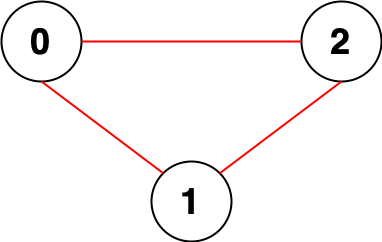
Input: n = 3, edges = [[0,1],[0,2],[1,2]]
Output: 0
Explanation: There are no pairs of nodes that are unreachable from each other. Therefore, we return 0.
Example 2:
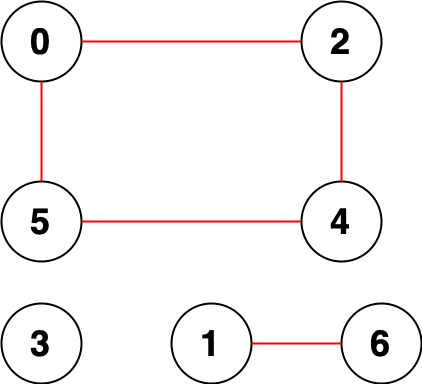
Input: n = 7, edges = [[0,2],[0,5],[2,4],[1,6],[5,4]]
Output: 14
Explanation: There are 14 pairs of nodes that are unreachable from each other:
[[0,1],[0,3],[0,6],[1,2],[1,3],[1,4],[1,5],[2,3],[2,6],[3,4],[3,5],[3,6],[4,6],[5,6]].
Therefore, we return 14.
Constraints:
1 <= n <= 1050 <= edges.length <= 2 * 105edges[i].length == 20 <= ai, bi < nai != bi- There are no repeated edges.
Solutions
Solution 1: DFS
For any two nodes in an undirected graph, if there is a path between them, then they are mutually reachable.
Therefore, we can use depth-first search to find the number of nodes t in each connected component, and then multiply the current number of nodes t in the connected component by the number of nodes s in all previous connected components to obtain the number of unreachable node pairs in the current connected component, which is s × t. Then, we add t to s and continue to search for the next connected component until all connected components have been searched, and we can obtain the final answer.
The time complexity is O(n + m), and the space complexity is O(n + m). Here, n and m are the number of nodes and edges, respectively.
PythonJavaC++GoTypeScriptRust
class Solution:
def countPairs(self, n: int, edges: List[List[int]]) -> int:
def dfs(i: int) -> int:
if vis[i]:
return 0
vis[i] = True
return 1 + sum(dfs(j) for j in g[i])
g = [[] for _ in range(n)]
for a, b in edges:
g[a].append(b)
g[b].append(a)
vis = [False] * n
ans = s = 0
for i in range(n):
t = dfs(i)
ans += s * t
s += t
return ans(code-box)
class Solution {
private List<Integer>[] g;
private boolean[] vis;
public long countPairs(int n, int[][] edges) {
g = new List[n];
vis = new boolean[n];
Arrays.setAll(g, i -> new ArrayList<>());
for (var e : edges) {
int a = e[0], b = e[1];
g[a].add(b);
g[b].add(a);
}
long ans = 0, s = 0;
for (int i = 0; i < n; ++i) {
int t = dfs(i);
ans += s * t;
s += t;
}
return ans;
}
private int dfs(int i) {
if (vis[i]) {
return 0;
}
vis[i] = true;
int cnt = 1;
for (int j : g[i]) {
cnt += dfs(j);
}
return cnt;
}
}(code-box)
class Solution {
public:
long long countPairs(int n, vector<vector<int>>& edges) {
vector<int> g[n];
for (auto& e : edges) {
int a = e[0], b = e[1];
g[a].push_back(b);
g[b].push_back(a);
}
bool vis[n];
memset(vis, 0, sizeof(vis));
function<int(int)> dfs = [&](int i) {
if (vis[i]) {
return 0;
}
vis[i] = true;
int cnt = 1;
for (int j : g[i]) {
cnt += dfs(j);
}
return cnt;
};
long long ans = 0, s = 0;
for (int i = 0; i < n; ++i) {
int t = dfs(i);
ans += s * t;
s += t;
}
return ans;
}
};(code-box)
func countPairs(n int, edges [][]int) (ans int64) {
g := make([][]int, n)
for _, e := range edges {
a, b := e[0], e[1]
g[a] = append(g[a], b)
g[b] = append(g[b], a)
}
vis := make([]bool, n)
var dfs func(int) int
dfs = func(i int) int {
if vis[i] {
return 0
}
vis[i] = true
cnt := 1
for _, j := range g[i] {
cnt += dfs(j)
}
return cnt
}
var s int64
for i := 0; i < n; i++ {
t := int64(dfs(i))
ans += s * t
s += t
}
return
}(code-box)
function countPairs(n: number, edges: number[][]): number {
const g: number[][] = Array.from({ length: n }, () => []);
for (const [a, b] of edges) {
g[a].push(b);
g[b].push(a);
}
const vis: boolean[] = Array(n).fill(false);
const dfs = (i: number): number => {
if (vis[i]) {
return 0;
}
vis[i] = true;
let cnt = 1;
for (const j of g[i]) {
cnt += dfs(j);
}
return cnt;
};
let [ans, s] = [0, 0];
for (let i = 0; i < n; ++i) {
const t = dfs(i);
ans += s * t;
s += t;
}
return ans;
}(code-box)
impl Solution {
pub fn count_pairs(n: i32, edges: Vec<Vec<i32>>) -> i64 {
let n = n as usize;
let mut g = vec![vec![]; n];
let mut vis = vec![false; n];
for e in edges {
let u = e[0] as usize;
let v = e[1] as usize;
g[u].push(v);
g[v].push(u);
}
fn dfs(g: &Vec<Vec<usize>>, vis: &mut Vec<bool>, u: usize) -> i64 {
if vis[u] {
return 0;
}
vis[u] = true;
let mut cnt = 1;
for &v in &g[u] {
cnt += dfs(g, vis, v);
}
cnt
}
let mut ans = 0;
let mut s = 0;
for u in 0..n {
let t = dfs(&g, &mut vis, u);
ans += t * s;
s += t;
}
ans
}
}(code-box)


