


Description
You are given the root of a binary tree with the following properties:
- Leaf nodes have either the value
0or1, representingfalseandtruerespectively. - Non-leaf nodes have either the value
2,3,4, or5, representing the boolean operationsOR,AND,XOR, andNOT, respectively.
You are also given a boolean result, which is the desired result of the evaluation of the root node.
The evaluation of a node is as follows:
- If the node is a leaf node, the evaluation is the value of the node, i.e.
trueorfalse. - Otherwise, evaluate the node's children and apply the boolean operation of its value with the children's evaluations.
In one operation, you can flip a leaf node, which causes a false node to become true, and a true node to become false.
Return the minimum number of operations that need to be performed such that the evaluation of root yields result. It can be shown that there is always a way to achieve result.
A leaf node is a node that has zero children.
Note: NOT nodes have either a left child or a right child, but other non-leaf nodes have both a left child and a right child.
Example 1:
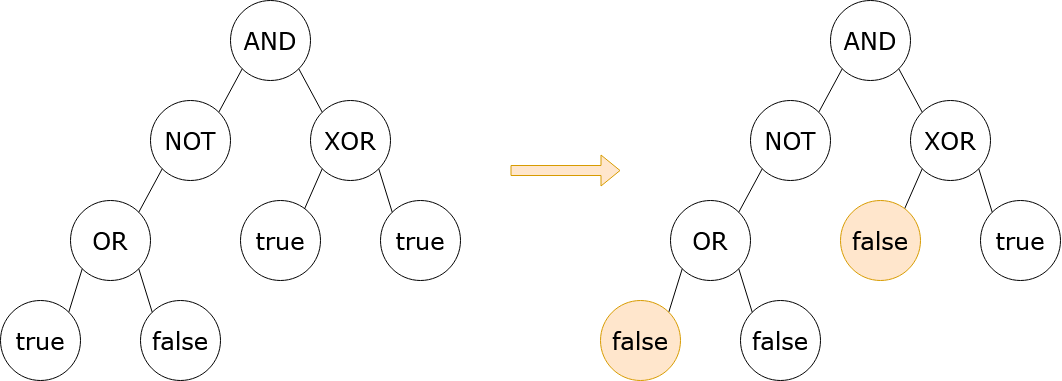
Input: root = [3,5,4,2,null,1,1,1,0], result = true
Output: 2
Explanation:
It can be shown that a minimum of 2 nodes have to be flipped to make the root of the tree
evaluate to true. One way to achieve this is shown in the diagram above.
Example 2:
Input: root = [0], result = false
Output: 0
Explanation:
The root of the tree already evaluates to false, so 0 nodes have to be flipped.
Constraints:
- The number of nodes in the tree is in the range
[1, 105]. 0 <= Node.val <= 5OR,AND, andXORnodes have2children.NOTnodes have1child.- Leaf nodes have a value of
0or1. - Non-leaf nodes have a value of
2,3,4, or5.
Solutions
Solution 1: Tree DP + Case Analysis
We define a function dfs(root), which returns an array of length 2. The first element represents the minimum number of flips needed to change the value of the root node to false, and the second element represents the minimum number of flips needed to change the value of the root node to true. The answer is dfs(root)[result].
The implementation of the function dfs(root) is as follows:
If root is null, return [+∞, +∞].
Otherwise, let x be the value of root, l be the return value of the left subtree, and r be the return value of the right subtree. Then we discuss the following cases:
- If x ∈ {0, 1}, return [x, x \oplus 1].
- If x = 2, which means the boolean operator is
OR, to make the value of rootfalse, we need to make both the left and right subtreesfalse. Therefore, the first element of the return value is l[0] + r[0]. To make the value of roottrue, we need at least one of the left or right subtrees to betrue. Therefore, the second element of the return value is min(l[0] + r[1], l[1] + r[0], l[1] + r[1]). - If x = 3, which means the boolean operator is
AND, to make the value of rootfalse, we need at least one of the left or right subtrees to befalse. Therefore, the first element of the return value is min(l[0] + r[0], l[0] + r[1], l[1] + r[0]). To make the value of roottrue, we need both the left and right subtrees to betrue. Therefore, the second element of the return value is l[1] + r[1]. - If x = 4, which means the boolean operator is
XOR, to make the value of rootfalse, we need both the left and right subtrees to be eitherfalseortrue. Therefore, the first element of the return value is min(l[0] + r[0], l[1] + r[1]). To make the value of roottrue, we need the left and right subtrees to be different. Therefore, the second element of the return value is min(l[0] + r[1], l[1] + r[0]). - If x = 5, which means the boolean operator is
NOT, to make the value of rootfalse, we need at least one of the left or right subtrees to betrue. Therefore, the first element of the return value is min(l[1], r[1]). To make the value of roottrue, we need at least one of the left or right subtrees to befalse. Therefore, the second element of the return value is min(l[0], r[0]).
The time complexity is O(n), and the space complexity is O(n). Where n is the number of nodes in the binary tree.
# Definition for a binary tree node. # class TreeNode: # def __init__(self, val=0, left=None, right=None): # self.val = val # self.left = left # self.right = right class Solution: def minimumFlips(self, root: Optional[TreeNode], result: bool) -> int: def dfs(root: Optional[TreeNode]) -> (int, int): if root is None: return inf, inf x = root.val if x in (0, 1): return x, x ^ 1 l, r = dfs(root.left), dfs(root.right) if x == 2: return l[0] + r[0], min(l[0] + r[1], l[1] + r[0], l[1] + r[1]) if x == 3: return min(l[0] + r[0], l[0] + r[1], l[1] + r[0]), l[1] + r[1] if x == 4: return min(l[0] + r[0], l[1] + r[1]), min(l[0] + r[1], l[1] + r[0]) return min(l[1], r[1]), min(l[0], r[0]) return dfs(root)[int(result)](code-box)
