


Description
You are given a 0-indexed m x n integer matrix grid consisting of distinct integers from 0 to m * n - 1. You can move in this matrix from a cell to any other cell in the next row. That is, if you are in cell (x, y) such that x < m - 1, you can move to any of the cells (x + 1, 0), (x + 1, 1), ..., (x + 1, n - 1). Note that it is not possible to move from cells in the last row.
Each possible move has a cost given by a 0-indexed 2D array moveCost of size (m * n) x n, where moveCost[i][j] is the cost of moving from a cell with value i to a cell in column j of the next row. The cost of moving from cells in the last row of grid can be ignored.
The cost of a path in grid is the sum of all values of cells visited plus the sum of costs of all the moves made. Return the minimum cost of a path that starts from any cell in the first row and ends at any cell in the last row.
Example 1:
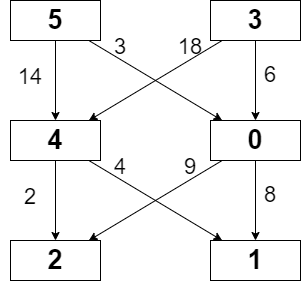
Input: grid = [[5,3],[4,0],[2,1]], moveCost = [[9,8],[1,5],[10,12],[18,6],[2,4],[14,3]]
Output: 17
Explanation: The path with the minimum possible cost is the path 5 -> 0 -> 1.
- The sum of the values of cells visited is 5 + 0 + 1 = 6.
- The cost of moving from 5 to 0 is 3.
- The cost of moving from 0 to 1 is 8.
So the total cost of the path is 6 + 3 + 8 = 17.
Example 2:
Input: grid = [[5,1,2],[4,0,3]], moveCost = [[12,10,15],[20,23,8],[21,7,1],[8,1,13],[9,10,25],[5,3,2]]
Output: 6
Explanation: The path with the minimum possible cost is the path 2 -> 3.
- The sum of the values of cells visited is 2 + 3 = 5.
- The cost of moving from 2 to 3 is 1.
So the total cost of this path is 5 + 1 = 6.
Constraints:
m == grid.lengthn == grid[i].length2 <= m, n <= 50gridconsists of distinct integers from0tom * n - 1.moveCost.length == m * nmoveCost[i].length == n1 <= moveCost[i][j] <= 100
Solutions
Solution 1: Dynamic Programming
We define f[i][j] to represent the minimum path cost from the first row to the ith row and jth column. Since we can only move from a column in the previous row to a column in the current row, the value of f[i][j] can be transferred from f[i - 1][k], where the range of k is [0, n - 1]. Therefore, the state transition equation is:
where moveCost[grid[i - 1][k]][j] represents the cost of moving from the kth column of the i - 1th row to the jth column of the ith row.
The final answer is min_{0 ≤ j < n} {f[m - 1][j]}.
Since each transition only needs the state of the previous row, we can use a rolling array to optimize the space complexity to O(n).
The time complexity is O(m × n2), and the space complexity is O(n). Here, m and n are the number of rows and columns of the grid, respectively.
class Solution: def minPathCost(self, grid: List[List[int]], moveCost: List[List[int]]) -> int: m, n = len(grid), len(grid[0]) f = grid[0] for i in range(1, m): g = [inf] * n for j in range(n): for k in range(n): g[j] = min(g[j], f[k] + moveCost[grid[i - 1][k]][j] + grid[i][j]) f = g return min(f)(code-box)
