
Description
You are given two integers m and n representing a 0-indexed m x n grid. You are also given two 2D integer arrays guards and walls where guards[i] = [rowi, coli] and walls[j] = [rowj, colj] represent the positions of the ith guard and jth wall respectively.
A guard can see every cell in the four cardinal directions (north, east, south, or west) starting from their position unless obstructed by a wall or another guard. A cell is guarded if there is at least one guard that can see it.
Return the number of unoccupied cells that are not guarded.
Example 1:
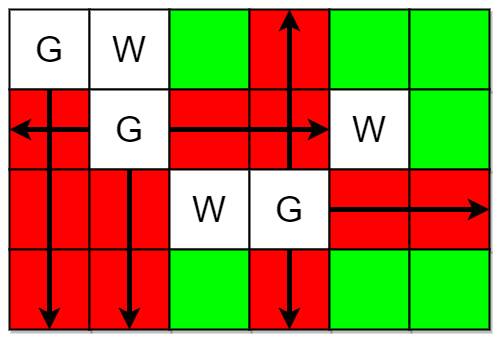
Input: m = 4, n = 6, guards = [[0,0],[1,1],[2,3]], walls = [[0,1],[2,2],[1,4]]
Output: 7
Explanation: The guarded and unguarded cells are shown in red and green respectively in the above diagram.
There are a total of 7 unguarded cells, so we return 7.
Example 2:
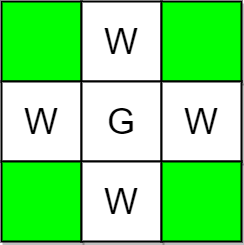
Input: m = 3, n = 3, guards = [[1,1]], walls = [[0,1],[1,0],[2,1],[1,2]]
Output: 4
Explanation: The unguarded cells are shown in green in the above diagram.
There are a total of 4 unguarded cells, so we return 4.
Constraints:
1 <= m, n <= 1052 <= m * n <= 1051 <= guards.length, walls.length <= 5 * 1042 <= guards.length + walls.length <= m * nguards[i].length == walls[j].length == 20 <= rowi, rowj < m0 <= coli, colj < n- All the positions in
guards and walls are unique.
Solutions
Solution 1: Simulation
We create a two-dimensional array g of size m × n, where g[i][j] represents the cell in row i and column j. Initially, the value of g[i][j] is 0, indicating that the cell is not guarded.
Then, we traverse all guards and walls, and set the value of g[i][j] to 2, indicating that these positions cannot be accessed.
Next, we traverse all guard positions, simulate in four directions from that position until we encounter a wall or guard, or go out of bounds. During the simulation, we set the value of the encountered cell to 1, indicating that the cell is guarded.
Finally, we traverse g and count the number of cells with a value of 0, which is the answer.
The time complexity is O(m × n), and the space complexity is O(m × n). Here, m and n are the number of rows and columns in the grid, respectively.
PythonJavaC++GoTypeScriptJavaScriptRustC#
class Solution:
def countUnguarded(
self, m: int, n: int, guards: List[List[int]], walls: List[List[int]]
) -> int:
g = [[0] * n for _ in range(m)]
for i, j in guards:
g[i][j] = 2
for i, j in walls:
g[i][j] = 2
dirs = (-1, 0, 1, 0, -1)
for i, j in guards:
for a, b in pairwise(dirs):
x, y = i, j
while 0 <= x + a < m and 0 <= y + b < n and g[x + a][y + b] < 2:
x, y = x + a, y + b
g[x][y] = 1
return sum(v == 0 for row in g for v in row)(code-box)
class Solution {
public int countUnguarded(int m, int n, int[][] guards, int[][] walls) {
int[][] g = new int[m][n];
for (var e : guards) {
g[e[0]][e[1]] = 2;
}
for (var e : walls) {
g[e[0]][e[1]] = 2;
}
int[] dirs = {-1, 0, 1, 0, -1};
for (var e : guards) {
for (int k = 0; k < 4; ++k) {
int x = e[0], y = e[1];
int a = dirs[k], b = dirs[k + 1];
while (x + a >= 0 && x + a < m && y + b >= 0 && y + b < n && g[x + a][y + b] < 2) {
x += a;
y += b;
g[x][y] = 1;
}
}
}
int ans = 0;
for (var row : g) {
for (int v : row) {
if (v == 0) {
++ans;
}
}
}
return ans;
}
}(code-box)
class Solution {
public:
int countUnguarded(int m, int n, vector<vector<int>>& guards, vector<vector<int>>& walls) {
int g[m][n];
memset(g, 0, sizeof(g));
for (auto& e : guards) {
g[e[0]][e[1]] = 2;
}
for (auto& e : walls) {
g[e[0]][e[1]] = 2;
}
int dirs[5] = {-1, 0, 1, 0, -1};
for (auto& e : guards) {
for (int k = 0; k < 4; ++k) {
int x = e[0], y = e[1];
int a = dirs[k], b = dirs[k + 1];
while (x + a >= 0 && x + a < m && y + b >= 0 && y + b < n && g[x + a][y + b] < 2) {
x += a;
y += b;
g[x][y] = 1;
}
}
}
int ans = 0;
for (auto& row : g) {
ans += count(row, row + n, 0);
}
return ans;
}
};(code-box)
func countUnguarded(m int, n int, guards [][]int, walls [][]int) (ans int) {
g := make([][]int, m)
for i := range g {
g[i] = make([]int, n)
}
for _, e := range guards {
g[e[0]][e[1]] = 2
}
for _, e := range walls {
g[e[0]][e[1]] = 2
}
dirs := [5]int{-1, 0, 1, 0, -1}
for _, e := range guards {
for k := 0; k < 4; k++ {
x, y := e[0], e[1]
a, b := dirs[k], dirs[k+1]
for x+a >= 0 && x+a < m && y+b >= 0 && y+b < n && g[x+a][y+b] < 2 {
x, y = x+a, y+b
g[x][y] = 1
}
}
}
for _, row := range g {
for _, v := range row {
if v == 0 {
ans++
}
}
}
return
}(code-box)
function countUnguarded(m: number, n: number, guards: number[][], walls: number[][]): number {
const g: number[][] = Array.from({ length: m }, () => Array.from({ length: n }, () => 0));
for (const [i, j] of guards) {
g[i][j] = 2;
}
for (const [i, j] of walls) {
g[i][j] = 2;
}
const dirs: number[] = [-1, 0, 1, 0, -1];
for (const [i, j] of guards) {
for (let k = 0; k < 4; ++k) {
let [x, y] = [i, j];
let [a, b] = [dirs[k], dirs[k + 1]];
while (x + a >= 0 && x + a < m && y + b >= 0 && y + b < n && g[x + a][y + b] < 2) {
x += a;
y += b;
g[x][y] = 1;
}
}
}
let ans = 0;
for (const row of g) {
for (const v of row) {
ans += v === 0 ? 1 : 0;
}
}
return ans;
}(code-box)
function countUnguarded(m, n, guards, walls) {
const g = Array.from({ length: m }, () => Array.from({ length: n }, () => 0));
for (const [i, j] of guards) {
g[i][j] = 2;
}
for (const [i, j] of walls) {
g[i][j] = 2;
}
const dirs = [-1, 0, 1, 0, -1];
for (const [i, j] of guards) {
for (let k = 0; k < 4; ++k) {
let [x, y] = [i, j];
let [a, b] = [dirs[k], dirs[k + 1]];
while (x + a >= 0 && x + a < m && y + b >= 0 && y + b < n && g[x + a][y + b] < 2) {
x += a;
y += b;
g[x][y] = 1;
}
}
}
let ans = 0;
for (const row of g) {
for (const v of row) {
ans += v === 0 ? 1 : 0;
}
}
return ans;
}(code-box)
impl Solution {
pub fn count_unguarded(m: i32, n: i32, guards: Vec<Vec<i32>>, walls: Vec<Vec<i32>>) -> i32 {
let m = m as usize;
let n = n as usize;
let mut g = vec![vec![0; n]; m];
for e in &guards {
g[e[0] as usize][e[1] as usize] = 2;
}
for e in &walls {
g[e[0] as usize][e[1] as usize] = 2;
}
let dirs = [-1, 0, 1, 0, -1];
for e in &guards {
let (x0, y0) = (e[0] as i32, e[1] as i32);
for k in 0..4 {
let (mut x, mut y) = (x0, y0);
let (a, b) = (dirs[k], dirs[k + 1]);
while x + a >= 0
&& x + a < m as i32
&& y + b >= 0
&& y + b < n as i32
&& g[(x + a) as usize][(y + b) as usize] < 2
{
x += a;
y += b;
g[x as usize][y as usize] = 1;
}
}
}
let mut ans = 0;
for row in g {
for v in row {
if v == 0 {
ans += 1;
}
}
}
ans
}
}(code-box)
public class Solution {
public int CountUnguarded(int m, int n, int[][] guards, int[][] walls) {
int[,] g = new int[m, n];
foreach (var e in guards) {
g[e[0], e[1]] = 2;
}
foreach (var e in walls) {
g[e[0], e[1]] = 2;
}
int[] dirs = { -1, 0, 1, 0, -1 };
foreach (var e in guards) {
int x0 = e[0], y0 = e[1];
for (int k = 0; k < 4; ++k) {
int x = x0, y = y0;
int a = dirs[k], b = dirs[k + 1];
while (x + a >= 0 && x + a < m && y + b >= 0 && y + b < n && g[x + a, y + b] < 2) {
x += a;
y += b;
g[x, y] = 1;
}
}
}
int ans = 0;
for (int i = 0; i < m; ++i) {
for (int j = 0; j < n; ++j) {
if (g[i, j] == 0) {
++ans;
}
}
}
return ans;
}
}(code-box)


