


Description
You are given a tree (i.e. a connected, undirected graph that has no cycles) rooted at node 0 consisting of n nodes numbered from 0 to n - 1. The tree is represented by a 0-indexed array parent of size n, where parent[i] is the parent of node i. Since node 0 is the root, parent[0] == -1.
You are also given a string s of length n, where s[i] is the character assigned to node i.
Return the length of the longest path in the tree such that no pair of adjacent nodes on the path have the same character assigned to them.
Example 1:
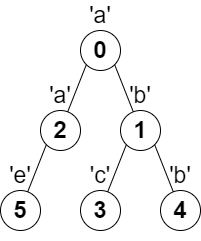
Input: parent = [-1,0,0,1,1,2], s = "abacbe"
Output: 3
Explanation: The longest path where each two adjacent nodes have different characters in the tree is the path: 0 -> 1 -> 3. The length of this path is 3, so 3 is returned.
It can be proven that there is no longer path that satisfies the conditions.
Example 2:
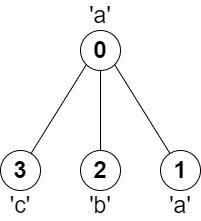
Input: parent = [-1,0,0,0], s = "aabc"
Output: 3
Explanation: The longest path where each two adjacent nodes have different characters is the path: 2 -> 0 -> 3. The length of this path is 3, so 3 is returned.
Constraints:
n == parent.length == s.length1 <= n <= 1050 <= parent[i] <= n - 1for alli >= 1parent[0] == -1parentrepresents a valid tree.sconsists of only lowercase English letters.
Solutions
Solution 1: Tree-shaped DP
First, we construct an adjacency list g based on the array parent, where g[i] represents all child nodes of node i.
Then we start DFS from the root node. For each node i, we traverse each child node j in g[i]. If s[i] ≠ s[j], then we can start from node i, pass through node j, and reach a leaf node. The length of this path is x = 1 + dfs(j). We use mx to record the longest path length starting from node i. At the same time, we update the answer ans = max(ans, mx + x) during the traversal process.
Finally, we return ans + 1.
The time complexity is O(n), and the space complexity is O(n), where n is the number of nodes.
class Solution: def longestPath(self, parent: List[int], s: str) -> int: def dfs(i: int) -> int: mx = 0 nonlocal ans for j in g[i]: x = dfs(j) + 1 if s[i] != s[j]: ans = max(ans, mx + x) mx = max(mx, x) return mx g = defaultdict(list) for i in range(1, len(parent)): g[parent[i]].append(i) ans = 0 dfs(0) return ans + 1(code-box)
