


Description
You are given a 0-indexed integer array nums, where nums[i] is a digit between 0 and 9 (inclusive).
The triangular sum of nums is the value of the only element present in nums after the following process terminates:
- Let
numscomprise ofnelements. Ifn == 1, end the process. Otherwise, create a new 0-indexed integer arraynewNumsof lengthn - 1. - For each index
i, where0 <= i < n - 1, assign the value ofnewNums[i]as(nums[i] + nums[i+1]) % 10, where%denotes modulo operator. - Replace the array
numswithnewNums. - Repeat the entire process starting from step 1.
Return the triangular sum of nums.
Example 1:
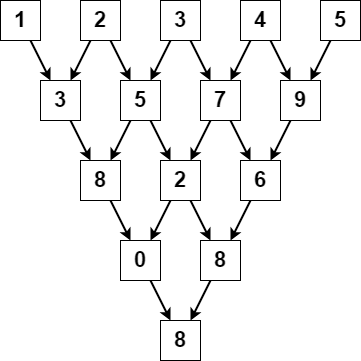
Input: nums = [1,2,3,4,5]
Output: 8
Explanation:
The above diagram depicts the process from which we obtain the triangular sum of the array.
Example 2:
Input: nums = [5]
Output: 5
Explanation:
Since there is only one element in nums, the triangular sum is the value of that element itself.
Constraints:
1 <= nums.length <= 10000 <= nums[i] <= 9
Solutions
Solution 1: Simulation
We can directly simulate the operations described in the problem. Perform n - 1 rounds of operations on the array nums, updating the array nums according to the rules described in the problem for each round. Finally, return the only remaining element in the array nums.
The time complexity is O(n2), where n is the length of the array nums. The space complexity is O(1).
PythonJavaC++GoTypeScriptRustC#
class Solution: def triangularSum(self, nums: List[int]) -> int: for k in range(len(nums) - 1, 0, -1): for i in range(k): nums[i] = (nums[i] + nums[i + 1]) % 10 return nums[0](code-box)
