


Description
You are given the head of a linked list.
The nodes in the linked list are sequentially assigned to non-empty groups whose lengths form the sequence of the natural numbers (1, 2, 3, 4, ...). The length of a group is the number of nodes assigned to it. In other words,
- The
1stnode is assigned to the first group. - The
2ndand the3rdnodes are assigned to the second group. - The
4th,5th, and6thnodes are assigned to the third group, and so on.
Note that the length of the last group may be less than or equal to 1 + the length of the second to last group.
Reverse the nodes in each group with an even length, and return the head of the modified linked list.
Example 1:

Input: head = [5,2,6,3,9,1,7,3,8,4]
Output: [5,6,2,3,9,1,4,8,3,7]
Explanation:
- The length of the first group is 1, which is odd, hence no reversal occurs.
- The length of the second group is 2, which is even, hence the nodes are reversed.
- The length of the third group is 3, which is odd, hence no reversal occurs.
- The length of the last group is 4, which is even, hence the nodes are reversed.
Example 2:
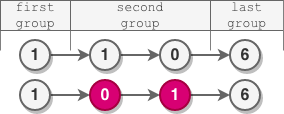
Input: head = [1,1,0,6]
Output: [1,0,1,6]
Explanation:
- The length of the first group is 1. No reversal occurs.
- The length of the second group is 2. The nodes are reversed.
- The length of the last group is 1. No reversal occurs.
Example 3:
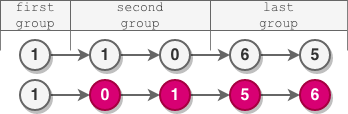
Input: head = [1,1,0,6,5]
Output: [1,0,1,5,6]
Explanation:
- The length of the first group is 1. No reversal occurs.
- The length of the second group is 2. The nodes are reversed.
- The length of the last group is 2. The nodes are reversed.
Constraints:
- The number of nodes in the list is in the range
[1, 105]. 0 <= Node.val <= 105
Solutions
Solution 1
PythonJavaTypeScript
# Definition for singly-linked list. # class ListNode: # def __init__(self, val=0, next=None): # self.val = val # self.next = next class Solution: def reverseEvenLengthGroups(self, head: Optional[ListNode]) -> Optional[ListNode]: def reverse(head, l): prev, cur, tail = None, head, head i = 0 while cur and i < l: t = cur.next cur.next = prev prev = cur cur = t i += 1 tail.next = cur return prev n = 0 t = head while t: t = t.next n += 1 dummy = ListNode(0, head) prev = dummy l = 1 while (1 + l) * l // 2 <= n and prev: if l % 2 == 0: prev.next = reverse(prev.next, l) i = 0 while i < l and prev: prev = prev.next i += 1 l += 1 left = n - l * (l - 1) // 2 if left > 0 and left % 2 == 0: prev.next = reverse(prev.next, left) return dummy.next(code-box)
