
Description
Given the head of a singly linked list that is sorted in non-decreasing order using the absolute values of its nodes, return the list sorted in non-decreasing order using the actual values of its nodes.
Example 1:
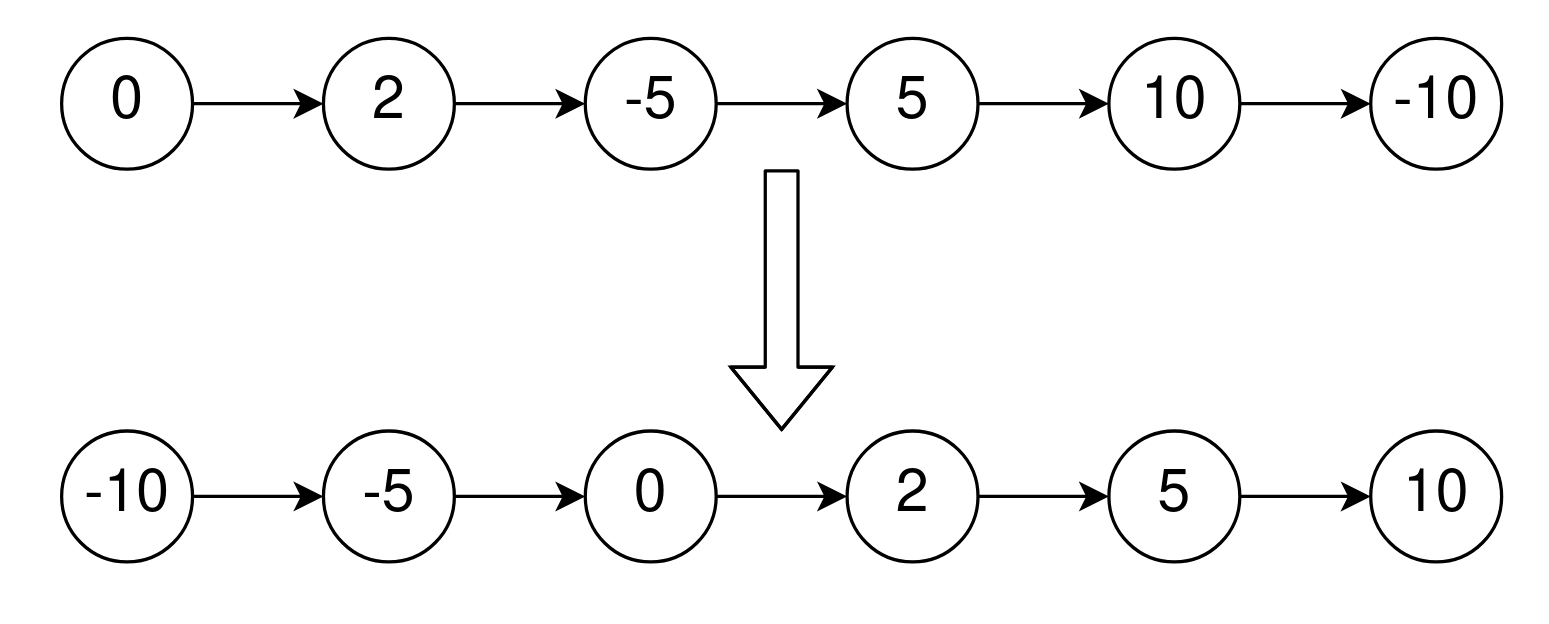
Input: head = [0,2,-5,5,10,-10]
Output: [-10,-5,0,2,5,10]
Explanation:
The list sorted in non-descending order using the absolute values of the nodes is [0,2,-5,5,10,-10].
The list sorted in non-descending order using the actual values is [-10,-5,0,2,5,10].
Example 2:
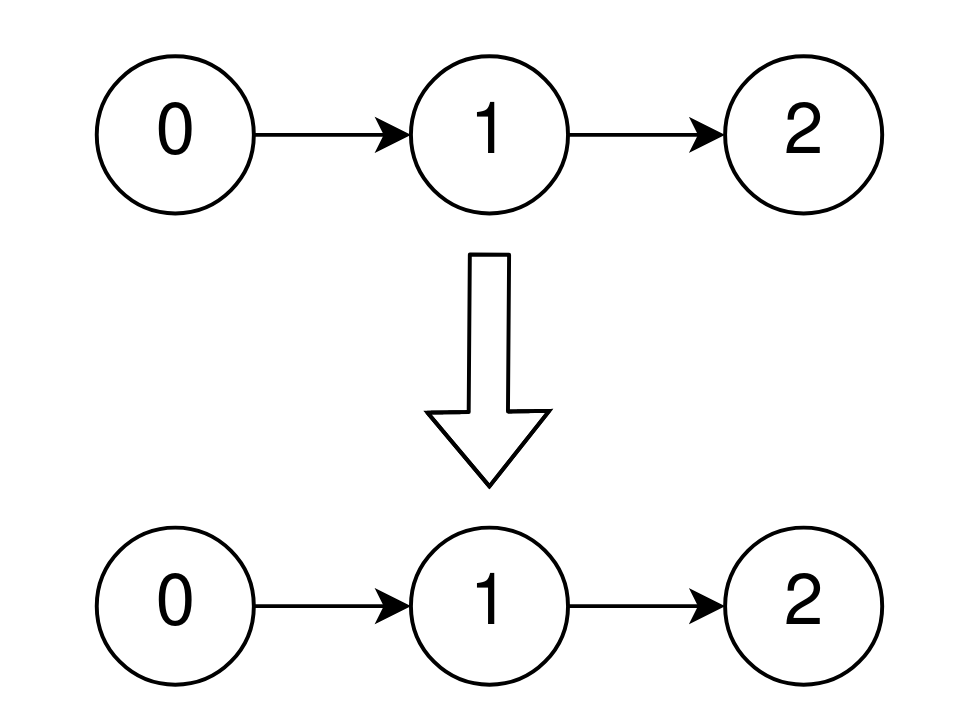
Input: head = [0,1,2]
Output: [0,1,2]
Explanation:
The linked list is already sorted in non-decreasing order.
Example 3:
Input: head = [1]
Output: [1]
Explanation:
The linked list is already sorted in non-decreasing order.
Constraints:
- The number of nodes in the list is the range
[1, 105].
-5000 <= Node.val <= 5000head is sorted in non-decreasing order using the absolute value of its nodes.
Follow up:
- Can you think of a solution with
O(n) time complexity?
Solutions
Solution 1: Head Insertion Method
We first assume that the first node is already sorted. Starting from the second node, when we encounter a node with a negative value, we use the head insertion method. For non-negative values, we continue to traverse down.
The time complexity is O(n), where n is the length of the linked list. The space complexity is O(1).
PythonJavaC++GoTypeScript
# Definition for singly-linked list.
# class ListNode:
# def __init__(self, val=0, next=None):
# self.val = val
# self.next = next
class Solution:
def sortLinkedList(self, head: Optional[ListNode]) -> Optional[ListNode]:
prev, curr = head, head.next
while curr:
if curr.val < 0:
t = curr.next
prev.next = t
curr.next = head
head = curr
curr = t
else:
prev, curr = curr, curr.next
return head(code-box)
/**
* Definition for singly-linked list.
* public class ListNode {
* int val;
* ListNode next;
* ListNode() {}
* ListNode(int val) { this.val = val; }
* ListNode(int val, ListNode next) { this.val = val; this.next = next; }
* }
*/
class Solution {
public ListNode sortLinkedList(ListNode head) {
ListNode prev = head, curr = head.next;
while (curr != null) {
if (curr.val < 0) {
ListNode t = curr.next;
prev.next = t;
curr.next = head;
head = curr;
curr = t;
} else {
prev = curr;
curr = curr.next;
}
}
return head;
}
}(code-box)
/**
* Definition for singly-linked list.
* struct ListNode {
* int val;
* ListNode *next;
* ListNode() : val(0), next(nullptr) {}
* ListNode(int x) : val(x), next(nullptr) {}
* ListNode(int x, ListNode *next) : val(x), next(next) {}
* };
*/
class Solution {
public:
ListNode* sortLinkedList(ListNode* head) {
ListNode* prev = head;
ListNode* curr = head->next;
while (curr) {
if (curr->val < 0) {
auto t = curr->next;
prev->next = t;
curr->next = head;
head = curr;
curr = t;
} else {
prev = curr;
curr = curr->next;
}
}
return head;
}
};(code-box)
/**
* Definition for singly-linked list.
* type ListNode struct {
* Val int
* Next *ListNode
* }
*/
func sortLinkedList(head *ListNode) *ListNode {
prev, curr := head, head.Next
for curr != nil {
if curr.Val < 0 {
t := curr.Next
prev.Next = t
curr.Next = head
head = curr
curr = t
} else {
prev, curr = curr, curr.Next
}
}
return head
}(code-box)
/**
* Definition for singly-linked list.
* class ListNode {
* val: number
* next: ListNode | null
* constructor(val?: number, next?: ListNode | null) {
* this.val = (val===undefined ? 0 : val)
* this.next = (next===undefined ? null : next)
* }
* }
*/
function sortLinkedList(head: ListNode | null): ListNode | null {
let [prev, curr] = [head, head.next];
while (curr !== null) {
if (curr.val < 0) {
const t = curr.next;
prev.next = t;
curr.next = head;
head = curr;
curr = t;
} else {
[prev, curr] = [curr, curr.next];
}
}
return head;
}(code-box)


