


Description
You are given a string s of length n, and an integer k. You are tasked to find the longest subsequence repeated k times in string s.
A subsequence is a string that can be derived from another string by deleting some or no characters without changing the order of the remaining characters.
A subsequence seq is repeated k times in the string s if seq * k is a subsequence of s, where seq * k represents a string constructed by concatenating seq k times.
- For example,
"bba"is repeated2times in the string"bababcba", because the string"bbabba", constructed by concatenating"bba"2times, is a subsequence of the string"bababcba".
Return the longest subsequence repeated k times in string s. If multiple such subsequences are found, return the lexicographically largest one. If there is no such subsequence, return an empty string.
Example 1:
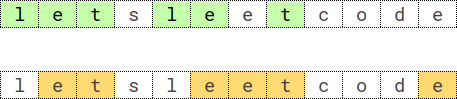
Input: s = "letsleetcode", k = 2
Output: "let"
Explanation: There are two longest subsequences repeated 2 times: "let" and "ete".
"let" is the lexicographically largest one.
Example 2:
Input: s = "bb", k = 2
Output: "b"
Explanation: The longest subsequence repeated 2 times is "b".
Example 3:
Input: s = "ab", k = 2
Output: ""
Explanation: There is no subsequence repeated 2 times. Empty string is returned.
Constraints:
n == s.length2 <= k <= 20002 <= n < min(2001, k * 8)sconsists of lowercase English letters.
Solutions
Solution 1: BFS
We can first count the occurrences of each character in the string, and then store the characters that appear at least k times in a list cs in ascending order. Next, we can use BFS to enumerate all possible subsequences.
We define a queue q, initially putting the empty string into the queue. Then, we take out a string cur from the queue and try to append each character c ∈ cs to the end of cur to form a new string nxt. If nxt is a subsequence that can be repeated k times, we add it to the answer and put nxt back into the queue for further processing.
We need an auxiliary function check(t, k) to determine whether the string t is a repeated k times subsequence of string s. Specifically, we can use two pointers to traverse s and t. If we can find all characters of t in s and repeat this process k times, then return true; otherwise, return false.
class Solution: def longestSubsequenceRepeatedK(self, s: str, k: int) -> str: def check(t: str, k: int) -> bool: i = 0 for c in s: if c == t[i]: i += 1 if i == len(t): k -= 1 if k == 0: return True i = 0 return False cnt = Counter(s) cs = [c for c in ascii_lowercase if cnt[c] >= k] q = deque([""]) ans = "" while q: cur = q.popleft() for c in cs: nxt = cur + c if check(nxt, k): ans = nxt q.append(nxt) return ans(code-box)
