
Description
You are given an m x n integer matrix grid, where m and n are both even integers, and an integer k.
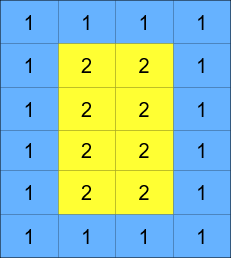
The matrix is composed of several layers, which is shown in the below image, where each color is its own layer:
A cyclic rotation of the matrix is done by cyclically rotating each layer in the matrix. To cyclically rotate a layer once, each element in the layer will take the place of the adjacent element in the counter-clockwise direction. An example rotation is shown below:
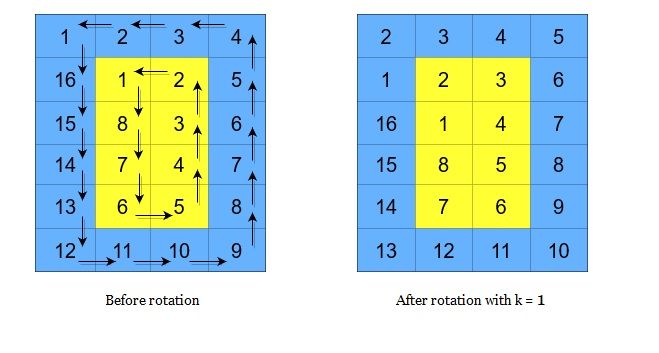
Return the matrix after applying k cyclic rotations to it.
Example 1:
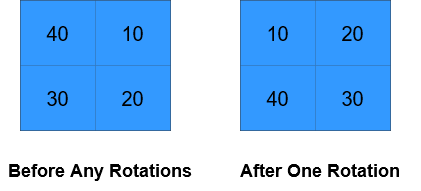
Input: grid = [[40,10],[30,20]], k = 1

Output: [[10,20],[40,30]]

Explanation: The figures above represent the grid at every state.
Example 2:
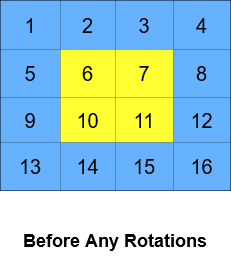
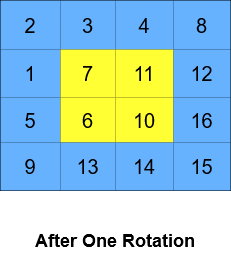
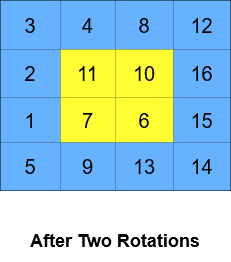
Input: grid = [[1,2,3,4],[5,6,7,8],[9,10,11,12],[13,14,15,16]], k = 2

Output: [[3,4,8,12],[2,11,10,16],[1,7,6,15],[5,9,13,14]]

Explanation: The figures above represent the grid at every state.
Constraints:
<li><code>m == grid.length</code></li>
<li><code>n == grid[i].length</code></li>
<li><code>2 <= m, n <= 50</code></li>
<li>Both <code>m</code> and <code>n</code> are <strong>even</strong> integers.</li>
<li><code>1 <= grid[i][j] <=<sup> </sup>5000</code></li>
<li><code>1 <= k <= 10<sup>9</sup></code></li>
Solutions
Solution 1
PythonJavaC++GoTypeScript
class Solution:
def rotateGrid(self, grid: List[List[int]], k: int) -> List[List[int]]:
def rotate(p: int, k: int):
nums = []
for j in range(p, n - p - 1):
nums.append(grid[p][j])
for i in range(p, m - p - 1):
nums.append(grid[i][n - p - 1])
for j in range(n - p - 1, p, -1):
nums.append(grid[m - p - 1][j])
for i in range(m - p - 1, p, -1):
nums.append(grid[i][p])
k %= len(nums)
if k == 0:
return
nums = nums[k:] + nums[:k]
k = 0
for j in range(p, n - p - 1):
grid[p][j] = nums[k]
k += 1
for i in range(p, m - p - 1):
grid[i][n - p - 1] = nums[k]
k += 1
for j in range(n - p - 1, p, -1):
grid[m - p - 1][j] = nums[k]
k += 1
for i in range(m - p - 1, p, -1):
grid[i][p] = nums[k]
k += 1
m, n = len(grid), len(grid[0])
for p in range(min(m, n) >> 1):
rotate(p, k)
return grid(code-box)
class Solution {
private int m;
private int n;
private int[][] grid;
public int[][] rotateGrid(int[][] grid, int k) {
m = grid.length;
n = grid[0].length;
this.grid = grid;
for (int p = 0; p < Math.min(m, n) / 2; ++p) {
rotate(p, k);
}
return grid;
}
private void rotate(int p, int k) {
List<Integer> nums = new ArrayList<>();
for (int j = p; j < n - p - 1; ++j) {
nums.add(grid[p][j]);
}
for (int i = p; i < m - p - 1; ++i) {
nums.add(grid[i][n - p - 1]);
}
for (int j = n - p - 1; j > p; --j) {
nums.add(grid[m - p - 1][j]);
}
for (int i = m - p - 1; i > p; --i) {
nums.add(grid[i][p]);
}
int l = nums.size();
k %= l;
if (k == 0) {
return;
}
for (int j = p; j < n - p - 1; ++j) {
grid[p][j] = nums.get(k++ % l);
}
for (int i = p; i < m - p - 1; ++i) {
grid[i][n - p - 1] = nums.get(k++ % l);
}
for (int j = n - p - 1; j > p; --j) {
grid[m - p - 1][j] = nums.get(k++ % l);
}
for (int i = m - p - 1; i > p; --i) {
grid[i][p] = nums.get(k++ % l);
}
}
}(code-box)
class Solution {
public:
vector<vector<int>> rotateGrid(vector<vector<int>>& grid, int k) {
int m = grid.size(), n = grid[0].size();
auto rotate = [&](int p, int k) {
vector<int> nums;
for (int j = p; j < n - p - 1; ++j) {
nums.push_back(grid[p][j]);
}
for (int i = p; i < m - p - 1; ++i) {
nums.push_back(grid[i][n - p - 1]);
}
for (int j = n - p - 1; j > p; --j) {
nums.push_back(grid[m - p - 1][j]);
}
for (int i = m - p - 1; i > p; --i) {
nums.push_back(grid[i][p]);
}
int l = nums.size();
k %= l;
if (k == 0) {
return;
}
for (int j = p; j < n - p - 1; ++j) {
grid[p][j] = nums[k++ % l];
}
for (int i = p; i < m - p - 1; ++i) {
grid[i][n - p - 1] = nums[k++ % l];
}
for (int j = n - p - 1; j > p; --j) {
grid[m - p - 1][j] = nums[k++ % l];
}
for (int i = m - p - 1; i > p; --i) {
grid[i][p] = nums[k++ % l];
}
};
for (int p = 0; p < min(m, n) / 2; ++p) {
rotate(p, k);
}
return grid;
}
};(code-box)
func rotateGrid(grid [][]int, k int) [][]int {
m, n := len(grid), len(grid[0])
rotate := func(p, k int) {
nums := []int{}
for j := p; j < n-p-1; j++ {
nums = append(nums, grid[p][j])
}
for i := p; i < m-p-1; i++ {
nums = append(nums, grid[i][n-p-1])
}
for j := n - p - 1; j > p; j-- {
nums = append(nums, grid[m-p-1][j])
}
for i := m - p - 1; i > p; i-- {
nums = append(nums, grid[i][p])
}
l := len(nums)
k %= l
if k == 0 {
return
}
for j := p; j < n-p-1; j++ {
grid[p][j] = nums[k]
k = (k + 1) % l
}
for i := p; i < m-p-1; i++ {
grid[i][n-p-1] = nums[k]
k = (k + 1) % l
}
for j := n - p - 1; j > p; j-- {
grid[m-p-1][j] = nums[k]
k = (k + 1) % l
}
for i := m - p - 1; i > p; i-- {
grid[i][p] = nums[k]
k = (k + 1) % l
}
}
for i := 0; i < m/2 && i < n/2; i++ {
rotate(i, k)
}
return grid
}(code-box)
function rotateGrid(grid: number[][], k: number): number[][] {
const m = grid.length;
const n = grid[0].length;
const rotate = (p: number, k: number) => {
const nums: number[] = [];
for (let j = p; j < n - p - 1; ++j) {
nums.push(grid[p][j]);
}
for (let i = p; i < m - p - 1; ++i) {
nums.push(grid[i][n - p - 1]);
}
for (let j = n - p - 1; j > p; --j) {
nums.push(grid[m - p - 1][j]);
}
for (let i = m - p - 1; i > p; --i) {
nums.push(grid[i][p]);
}
const l = nums.length;
k %= l;
if (k === 0) {
return;
}
for (let j = p; j < n - p - 1; ++j) {
grid[p][j] = nums[k++ % l];
}
for (let i = p; i < m - p - 1; ++i) {
grid[i][n - p - 1] = nums[k++ % l];
}
for (let j = n - p - 1; j > p; --j) {
grid[m - p - 1][j] = nums[k++ % l];
}
for (let i = m - p - 1; i > p; --i) {
grid[i][p] = nums[k++ % l];
}
};
for (let p = 0; p < Math.min(m, n) >> 1; ++p) {
rotate(p, k);
}
return grid;
}(code-box)


