


Description
There is a 3 lane road of length n that consists of n + 1 points labeled from 0 to n. A frog starts at point 0 in the second lane and wants to jump to point n. However, there could be obstacles along the way.
You are given an array obstacles of length n + 1 where each obstacles[i] (ranging from 0 to 3) describes an obstacle on the lane obstacles[i] at point i. If obstacles[i] == 0, there are no obstacles at point i. There will be at most one obstacle in the 3 lanes at each point.
- For example, if
obstacles[2] == 1, then there is an obstacle on lane 1 at point 2.
The frog can only travel from point i to point i + 1 on the same lane if there is not an obstacle on the lane at point i + 1. To avoid obstacles, the frog can also perform a side jump to jump to another lane (even if they are not adjacent) at the same point if there is no obstacle on the new lane.
- For example, the frog can jump from lane 3 at point 3 to lane 1 at point 3.
Return the minimum number of side jumps the frog needs to reach any lane at point n starting from lane 2 at point 0.
Note: There will be no obstacles on points 0 and n.
Example 1:
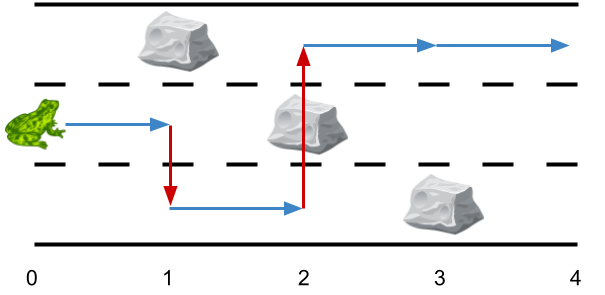
Input: obstacles = [0,1,2,3,0]
Output: 2
Explanation: The optimal solution is shown by the arrows above. There are 2 side jumps (red arrows).
Note that the frog can jump over obstacles only when making side jumps (as shown at point 2).
Example 2:
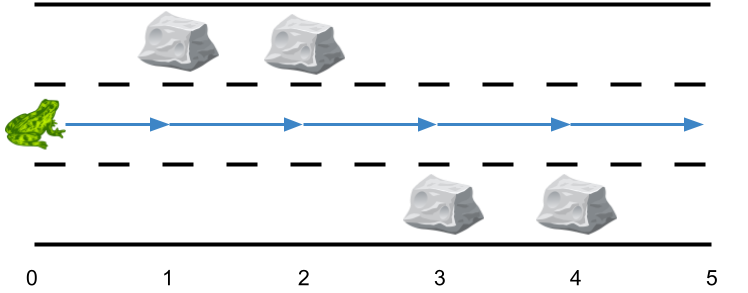
Input: obstacles = [0,1,1,3,3,0]
Output: 0
Explanation: There are no obstacles on lane 2. No side jumps are required.
Example 3:
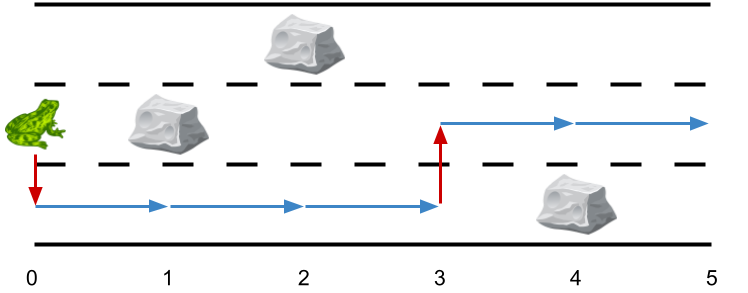
Input: obstacles = [0,2,1,0,3,0]
Output: 2
Explanation: The optimal solution is shown by the arrows above. There are 2 side jumps.
Constraints:
obstacles.length == n + 11 <= n <= 5 * 1050 <= obstacles[i] <= 3obstacles[0] == obstacles[n] == 0
Solutions
Solution 1: Dynamic Programming
We define f[i][j] as the minimum number of sidesteps for the frog to reach the i-th point and be on the j-th lane (index starts from 0).
Note that the frog starts on the second lane (the problem index starts from 1), so the value of f[0][1] is 0, and the values of f[0][0] and f[0][2] are both 1. The answer is min(f[n][0], f[n][1], f[n][2]).
For each position i from 1 to n, we can enumerate the current lane j of the frog. If obstacles[i] = j + 1, it means that there is an obstacle on the j-th lane, and the value of f[i][j] is infinity. Otherwise, the frog can choose not to jump, in which case the value of f[i][j] is f[i - 1][j], or the frog can sidestep from other lanes, in which case f[i][j] = min(f[i][j], min(f[i][0], f[i][1], f[i][2]) + 1).
In the code implementation, we can optimize the first dimension of space and only use an array f of length 3 for maintenance.
The time complexity is O(n), where n is the length of the array obstacles. The space complexity is O(1).
class Solution: def minSideJumps(self, obstacles: List[int]) -> int: f = [1, 0, 1] for v in obstacles[1:]: for j in range(3): if v == j + 1: f[j] = inf break x = min(f) + 1 for j in range(3): if v != j + 1: f[j] = min(f[j], x) return min(f)(code-box)
