


Description
You are given an array nums that consists of positive integers.
The GCD of a sequence of numbers is defined as the greatest integer that divides all the numbers in the sequence evenly.
- For example, the GCD of the sequence
[4,6,16]is2.
A subsequence of an array is a sequence that can be formed by removing some elements (possibly none) of the array.
- For example,
[2,5,10]is a subsequence of[1,2,1,2,4,1,5,10].
Return the number of different GCDs among all non-empty subsequences of nums.
Example 1:
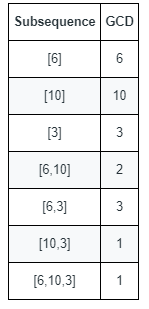
Input: nums = [6,10,3]
Output: 5
Explanation: The figure shows all the non-empty subsequences and their GCDs.
The different GCDs are 6, 10, 3, 2, and 1.
Example 2:
Input: nums = [5,15,40,5,6]
Output: 7
Constraints:
1 <= nums.length <= 1051 <= nums[i] <= 2 * 105
Solutions
Solution 1: Enumeration + Mathematics
For all sub-sequences of the array nums, their greatest common divisor (GCD) will not exceed the maximum value mx in the array.
Therefore, we can enumerate each number x in [1,.. mx], and determine whether x is the GCD of a sub-sequence of the array nums. If it is, then we increment the answer by one.
So the problem is transformed into: determining whether x is the GCD of a sub-sequence of the array nums. We can do this by enumerating the multiples y of x, and checking whether y exists in the array nums. If y exists in the array nums, then we calculate the GCD g of y. If g = x occurs, then x is the GCD of a sub-sequence of the array nums.
The time complexity is O(n + M × log M), and the space complexity is O(M). Here, n and M are the length of the array nums and the maximum value in the array nums, respectively.
class Solution: def countDifferentSubsequenceGCDs(self, nums: List[int]) -> int: mx = max(nums) vis = set(nums) ans = 0 for x in range(1, mx + 1): g = 0 for y in range(x, mx + 1, x): if y in vis: g = gcd(g, y) if g == x: ans += 1 break return ans(code-box)
