


Description
You are given coordinates, a string that represents the coordinates of a square of the chessboard. Below is a chessboard for your reference.
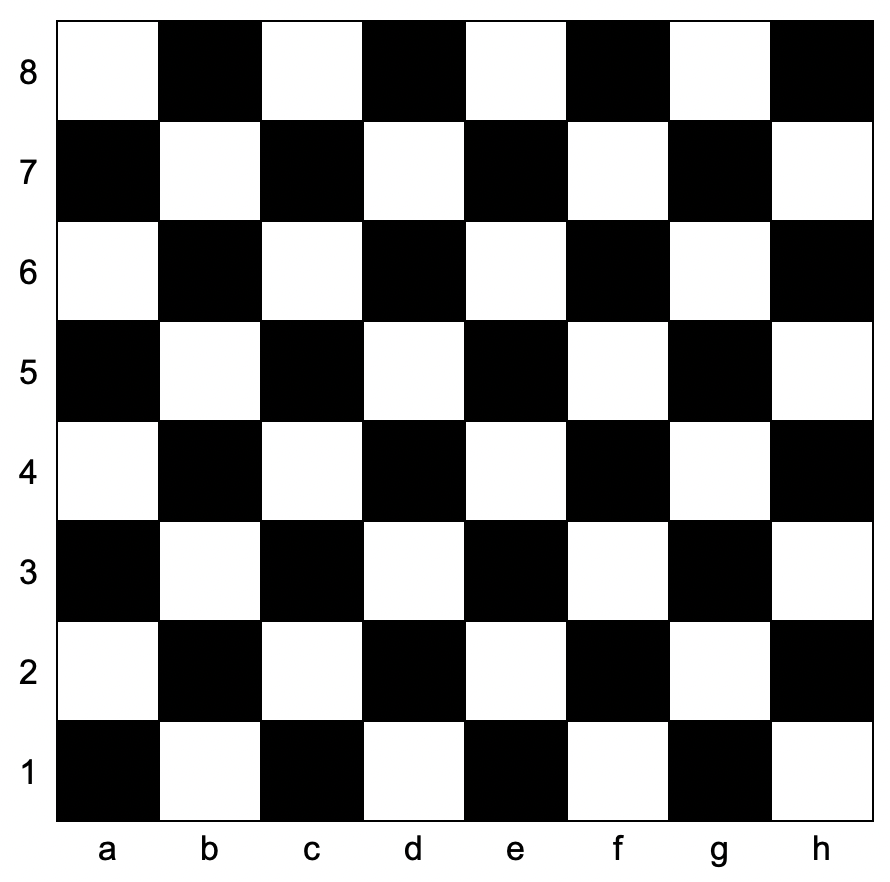
Return true if the square is white, and false if the square is black.
The coordinate will always represent a valid chessboard square. The coordinate will always have the letter first, and the number second.
Example 1:
Input: coordinates = "a1"
Output: false
Explanation: From the chessboard above, the square with coordinates "a1" is black, so return false.
Example 2:
Input: coordinates = "h3"
Output: true
Explanation: From the chessboard above, the square with coordinates "h3" is white, so return true.
Example 3:
Input: coordinates = "c7"
Output: false
Constraints:
coordinates.length == 2'a' <= coordinates[0] <= 'h''1' <= coordinates[1] <= '8'
Solutions
Solution 1: Pattern Recognition
Observing the chessboard, we find that two squares (x1, y1) and (x2, y2) with the same color satisfy that both x1 + y1 and x2 + y2 are either odd or even.
Therefore, we can get the corresponding coordinates (x, y) from coordinates. If x + y is odd, the square is white, and we return true; otherwise, we return false.
The time complexity is O(1), and the space complexity is O(1).
class Solution: def squareIsWhite(self, coordinates: str) -> bool: return (ord(coordinates[0]) + ord(coordinates[1])) % 2 == 1(code-box)
