
Description
You are given four integers, m, n, introvertsCount, and extrovertsCount. You have an m x n grid, and there are two types of people: introverts and extroverts. There are introvertsCount introverts and extrovertsCount extroverts.
You should decide how many people you want to live in the grid and assign each of them one grid cell. Note that you do not have to have all the people living in the grid.
The happiness of each person is calculated as follows:
- Introverts start with
120 happiness and lose 30 happiness for each neighbor (introvert or extrovert).
- Extroverts start with
40 happiness and gain 20 happiness for each neighbor (introvert or extrovert).
Neighbors live in the directly adjacent cells north, east, south, and west of a person's cell.
The grid happiness is the sum of each person's happiness. Return the maximum possible grid happiness.
Example 1:
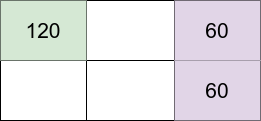
Input: m = 2, n = 3, introvertsCount = 1, extrovertsCount = 2
Output: 240
Explanation: Assume the grid is 1-indexed with coordinates (row, column).
We can put the introvert in cell (1,1) and put the extroverts in cells (1,3) and (2,3).
- Introvert at (1,1) happiness: 120 (starting happiness) - (0 * 30) (0 neighbors) = 120
- Extrovert at (1,3) happiness: 40 (starting happiness) + (1 * 20) (1 neighbor) = 60
- Extrovert at (2,3) happiness: 40 (starting happiness) + (1 * 20) (1 neighbor) = 60
The grid happiness is 120 + 60 + 60 = 240.
The above figure shows the grid in this example with each person's happiness. The introvert stays in the light green cell while the extroverts live on the light purple cells.
Example 2:
Input: m = 3, n = 1, introvertsCount = 2, extrovertsCount = 1
Output: 260
Explanation: Place the two introverts in (1,1) and (3,1) and the extrovert at (2,1).
- Introvert at (1,1) happiness: 120 (starting happiness) - (1 * 30) (1 neighbor) = 90
- Extrovert at (2,1) happiness: 40 (starting happiness) + (2 * 20) (2 neighbors) = 80
- Introvert at (3,1) happiness: 120 (starting happiness) - (1 * 30) (1 neighbor) = 90
The grid happiness is 90 + 80 + 90 = 260.
Example 3:
Input: m = 2, n = 2, introvertsCount = 4, extrovertsCount = 0
Output: 240
Constraints:
1 <= m, n <= 50 <= introvertsCount, extrovertsCount <= min(m * n, 6)
Solutions
Solution 1: Ternary State Compression + Memoization
We notice that in the problem, 1 ≤ m, n ≤ 5, and each grid cell has three states: no personnel assigned, introverted personnel assigned, and extroverted personnel assigned. Therefore, we can use 0, 1, 2 to represent these three states, and each row in the grid can be represented by a ternary number of length n.
We define a function dfs(i, pre, ic, ec), which represents the maximum happiness of the grid starting from the i-th row, with the state of the previous row being pre, ic introverted people left, and ec extroverted people left. The answer is dfs(0, 0, introvertsCount, extrovertsCount).
The calculation process of the function dfs(i, pre, ic, ec) is as follows:
If i = m, it means that all rows have been processed, so return 0;
If ic = 0 and ec = 0, it means that all people have been assigned, so return 0;
Otherwise, enumerate the current row's state cur, where cur ∈ [0, 3n), then calculate the happiness f[cur] of the current row, and the contribution g[pre][cur] to the happiness between the state pre of the previous row, and recursively calculate dfs(i + 1, cur, ic - ix[cur], ec - ex[cur]), finally return the maximum value of f[cur] + g[pre][cur] + dfs(i + 1, cur, ic - ix[cur], ec - ex[cur]), that is:
dfs(i, pre, ic, ec) = max_{cur} {f[cur] + g[pre][cur] + dfs(i + 1, cur, ic - ix[cur], ec - ex[cur])}
Where:
- ix[cur] represents the number of introverted people in state cur;
- ex[cur] represents the number of extroverted people in state cur;
- f[cur] represents the initial happiness of the people in state cur;
- g[pre][cur] represents the contribution to happiness of two adjacent state rows.
These values can be obtained through preprocessing. And we can use the method of memoization to avoid repeated calculations.
The time complexity is O(32n × (m × ic × ec + n)), and the space complexity is O(32n + 3n × m × ic × ec). Where ic and ec represent the number of introverted and extroverted people, respectively.
PythonJavaC++GoTypeScript
class Solution:
def getMaxGridHappiness(
self, m: int, n: int, introvertsCount: int, extrovertsCount: int
) -> int:
@cache
def dfs(i: int, pre: int, ic: int, ec: int) -> int:
if i == m or (ic == 0 and ec == 0):
return 0
ans = 0
for cur in range(mx):
if ix[cur] <= ic and ex[cur] <= ec:
a = f[cur] + g[pre][cur]
b = dfs(i + 1, cur, ic - ix[cur], ec - ex[cur])
ans = max(ans, a + b)
return ans
mx = pow(3, n)
f = [0] * mx
g = [[0] * mx for _ in range(mx)]
h = [[0, 0, 0], [0, -60, -10], [0, -10, 40]]
bits = [[0] * n for _ in range(mx)]
ix = [0] * mx
ex = [0] * mx
for i in range(mx):
mask = i
for j in range(n):
mask, x = divmod(mask, 3)
bits[i][j] = x
if x == 1:
ix[i] += 1
f[i] += 120
elif x == 2:
ex[i] += 1
f[i] += 40
if j:
f[i] += h[x][bits[i][j - 1]]
for i in range(mx):
for j in range(mx):
for k in range(n):
g[i][j] += h[bits[i][k]][bits[j][k]]
return dfs(0, 0, introvertsCount, extrovertsCount)(code-box)
class Solution {
private int m;
private int mx;
private int[] f;
private int[][] g;
private int[][] bits;
private int[] ix;
private int[] ex;
private Integer[][][][] memo;
private final int[][] h = {{0, 0, 0}, {0, -60, -10}, {0, -10, 40}};
public int getMaxGridHappiness(int m, int n, int introvertsCount, int extrovertsCount) {
this.m = m;
mx = (int) Math.pow(3, n);
f = new int[mx];
g = new int[mx][mx];
bits = new int[mx][n];
ix = new int[mx];
ex = new int[mx];
memo = new Integer[m][mx][introvertsCount + 1][extrovertsCount + 1];
for (int i = 0; i < mx; ++i) {
int mask = i;
for (int j = 0; j < n; ++j) {
int x = mask % 3;
mask /= 3;
bits[i][j] = x;
if (x == 1) {
ix[i]++;
f[i] += 120;
} else if (x == 2) {
ex[i]++;
f[i] += 40;
}
if (j > 0) {
f[i] += h[x][bits[i][j - 1]];
}
}
}
for (int i = 0; i < mx; ++i) {
for (int j = 0; j < mx; ++j) {
for (int k = 0; k < n; ++k) {
g[i][j] += h[bits[i][k]][bits[j][k]];
}
}
}
return dfs(0, 0, introvertsCount, extrovertsCount);
}
private int dfs(int i, int pre, int ic, int ec) {
if (i == m || (ic == 0 && ec == 0)) {
return 0;
}
if (memo[i][pre][ic][ec] != null) {
return memo[i][pre][ic][ec];
}
int ans = 0;
for (int cur = 0; cur < mx; ++cur) {
if (ix[cur] <= ic && ex[cur] <= ec) {
ans = Math.max(
ans, f[cur] + g[pre][cur] + dfs(i + 1, cur, ic - ix[cur], ec - ex[cur]));
}
}
return memo[i][pre][ic][ec] = ans;
}
}(code-box)
class Solution {
public:
int getMaxGridHappiness(int m, int n, int introvertsCount, int extrovertsCount) {
int mx = pow(3, n);
int f[mx];
int g[mx][mx];
int bits[mx][n];
int ix[mx];
int ex[mx];
int memo[m][mx][introvertsCount + 1][extrovertsCount + 1];
int h[3][3] = {{0, 0, 0}, {0, -60, -10}, {0, -10, 40}};
memset(f, 0, sizeof(f));
memset(g, 0, sizeof(g));
memset(bits, 0, sizeof(bits));
memset(ix, 0, sizeof(ix));
memset(ex, 0, sizeof(ex));
memset(memo, -1, sizeof(memo));
for (int i = 0; i < mx; ++i) {
int mask = i;
for (int j = 0; j < n; ++j) {
int x = mask % 3;
mask /= 3;
bits[i][j] = x;
if (x == 1) {
ix[i]++;
f[i] += 120;
} else if (x == 2) {
ex[i]++;
f[i] += 40;
}
if (j) {
f[i] += h[x][bits[i][j - 1]];
}
}
}
for (int i = 0; i < mx; ++i) {
for (int j = 0; j < mx; ++j) {
for (int k = 0; k < n; ++k) {
g[i][j] += h[bits[i][k]][bits[j][k]];
}
}
}
function<int(int, int, int, int)> dfs = [&](int i, int pre, int ic, int ec) {
if (i == m || (ic == 0 && ec == 0)) {
return 0;
}
if (memo[i][pre][ic][ec] != -1) {
return memo[i][pre][ic][ec];
}
int ans = 0;
for (int cur = 0; cur < mx; ++cur) {
if (ix[cur] <= ic && ex[cur] <= ec) {
ans = max(ans, f[cur] + g[pre][cur] + dfs(i + 1, cur, ic - ix[cur], ec - ex[cur]));
}
}
return memo[i][pre][ic][ec] = ans;
};
return dfs(0, 0, introvertsCount, extrovertsCount);
}
};(code-box)
func getMaxGridHappiness(m int, n int, introvertsCount int, extrovertsCount int) int {
mx := int(math.Pow(3, float64(n)))
f := make([]int, mx)
g := make([][]int, mx)
h := [3][3]int{{0, 0, 0}, {0, -60, -10}, {0, -10, 40}}
bits := make([][]int, mx)
ix := make([]int, mx)
ex := make([]int, mx)
memo := make([][][][]int, m)
for i := range g {
g[i] = make([]int, mx)
bits[i] = make([]int, n)
}
for i := range memo {
memo[i] = make([][][]int, mx)
for j := range memo[i] {
memo[i][j] = make([][]int, introvertsCount+1)
for k := range memo[i][j] {
memo[i][j][k] = make([]int, extrovertsCount+1)
for l := range memo[i][j][k] {
memo[i][j][k][l] = -1
}
}
}
}
for i := 0; i < mx; i++ {
mask := i
for j := 0; j < n; j++ {
x := mask % 3
mask /= 3
bits[i][j] = x
if x == 1 {
ix[i]++
f[i] += 120
} else if x == 2 {
ex[i]++
f[i] += 40
}
if j > 0 {
f[i] += h[x][bits[i][j-1]]
}
}
}
for i := 0; i < mx; i++ {
for j := 0; j < mx; j++ {
for k := 0; k < n; k++ {
g[i][j] += h[bits[i][k]][bits[j][k]]
}
}
}
var dfs func(int, int, int, int) int
dfs = func(i, pre, ic, ec int) int {
if i == m || (ic == 0 && ec == 0) {
return 0
}
if memo[i][pre][ic][ec] != -1 {
return memo[i][pre][ic][ec]
}
ans := 0
for cur := 0; cur < mx; cur++ {
if ix[cur] <= ic && ex[cur] <= ec {
ans = max(ans, f[cur]+g[pre][cur]+dfs(i+1, cur, ic-ix[cur], ec-ex[cur]))
}
}
memo[i][pre][ic][ec] = ans
return ans
}
return dfs(0, 0, introvertsCount, extrovertsCount)
}(code-box)
function getMaxGridHappiness(
m: number,
n: number,
introvertsCount: number,
extrovertsCount: number,
): number {
const mx = 3 ** n;
const f: number[] = Array(mx).fill(0);
const g: number[][] = Array(mx)
.fill(0)
.map(() => Array(mx).fill(0));
const h: number[][] = [
[0, 0, 0],
[0, -60, -10],
[0, -10, 40],
];
const bits: number[][] = Array(mx)
.fill(0)
.map(() => Array(n).fill(0));
const ix: number[] = Array(mx).fill(0);
const ex: number[] = Array(mx).fill(0);
const memo: number[][][][] = Array(m)
.fill(0)
.map(() =>
Array(mx)
.fill(0)
.map(() =>
Array(introvertsCount + 1)
.fill(0)
.map(() => Array(extrovertsCount + 1).fill(-1)),
),
);
for (let i = 0; i < mx; ++i) {
let mask = i;
for (let j = 0; j < n; ++j) {
const x = mask % 3;
mask = Math.floor(mask / 3);
bits[i][j] = x;
if (x === 1) {
ix[i] += 1;
f[i] += 120;
} else if (x === 2) {
ex[i] += 1;
f[i] += 40;
}
if (j > 0) {
f[i] += h[x][bits[i][j - 1]];
}
}
}
for (let i = 0; i < mx; ++i) {
for (let j = 0; j < mx; ++j) {
for (let k = 0; k < n; ++k) {
g[i][j] += h[bits[i][k]][bits[j][k]];
}
}
}
const dfs = (i: number, pre: number, ic: number, ec: number): number => {
if (i === m || (ic === 0 && ec === 0)) {
return 0;
}
if (memo[i][pre][ic][ec] !== -1) {
return memo[i][pre][ic][ec];
}
let ans = 0;
for (let cur = 0; cur < mx; ++cur) {
if (ix[cur] <= ic && ex[cur] <= ec) {
const a = f[cur] + g[pre][cur];
const b = dfs(i + 1, cur, ic - ix[cur], ec - ex[cur]);
ans = Math.max(ans, a + b);
}
}
return (memo[i][pre][ic][ec] = ans);
};
return dfs(0, 0, introvertsCount, extrovertsCount);
}(code-box)
Solution 2: Contour Line Memorized Search
We can consider searching each grid cell, each time searching a position (i, j), we denote pos = i × n + j. Then its left and upper adjacent grids will affect their happiness contribution.
We define a function dfs(pos, pre, ic, ec), which represents the maximum happiness of the grid when we search to position pos, and the state of the previous n grid cells is pre, with ic introverted people left, and ec extroverted people left. The answer is dfs(0, 0, introvertsCount, extrovertsCount).
The calculation process of the function dfs(pos, pre, ic, ec) is as follows:
If pos = m × n, it means that all grid cells have been processed, so return 0;
If ic = 0 and ec = 0, it means that all people have been assigned, so return 0;
Otherwise, we calculate the state up = pre⁄3n-1 of the upper adjacent grid cell of the current grid cell based on pre, and the state left = pre \bmod 3 of the left adjacent grid cell (note that if pos is in the 0-th column, then left = 0).
Next, we enumerate the state i of the current grid cell, where i ∈ [0, 3). Then the state of the current n grid cells is cur = pre \bmod 3n-1 × 3 + i, and the happiness contribution of the current grid cell and its left and upper adjacent grid cells is h[up][i]+h[left][i]; the happiness of the current grid cell itself depends on whether personnel are assigned to this position, and whether the assigned personnel are introverted or extroverted. If they are introverted, the happiness is 120, if they are extroverted, the happiness is 40, otherwise, the happiness is 0; then, if personnel are assigned to the current grid cell, we need to update ic or ec when we recursively call the function. Accumulate these happiness values, and take the maximum value as the return value of the function.
Similar to Solution 1, we can also use the method of memoization to avoid repeated calculations.
The time complexity is O(3n+1 × m × n × ic × ec), and the space complexity is O(3n × m × n × ic × ec). Where ic and ec represent the number of introverted and extroverted people, respectively.
PythonJavaC++GoTypeScript
class Solution:
def getMaxGridHappiness(
self, m: int, n: int, introvertsCount: int, extrovertsCount: int
) -> int:
@cache
def dfs(pos: int, pre: int, ic: int, ec: int) -> int:
if pos == m * n or (ic == 0 and ec == 0):
return 0
ans = 0
up = pre // p
left = 0 if pos % n == 0 else pre % 3
for i in range(3):
if (i == 1 and ic == 0) or (i == 2 and ec == 0):
continue
cur = pre % p * 3 + i
a = h[up][i] + h[left][i]
b = dfs(pos + 1, cur, ic - (i == 1), ec - (i == 2))
c = 0
if i == 1:
c = 120
elif i == 2:
c = 40
ans = max(ans, a + b + c)
return ans
p = pow(3, n - 1)
h = [[0, 0, 0], [0, -60, -10], [0, -10, 40]]
return dfs(0, 0, introvertsCount, extrovertsCount)(code-box)
class Solution {
private int m;
private int n;
private int p;
private final int[][] h = {{0, 0, 0}, {0, -60, -10}, {0, -10, 40}};
private Integer[][][][] memo;
public int getMaxGridHappiness(int m, int n, int introvertsCount, int extrovertsCount) {
this.m = m;
this.n = n;
p = (int) Math.pow(3, n - 1);
memo = new Integer[m * n][p * 3][introvertsCount + 1][extrovertsCount + 1];
return dfs(0, 0, introvertsCount, extrovertsCount);
}
private int dfs(int pos, int pre, int ic, int ec) {
if (pos == m * n || (ic == 0 && ec == 0)) {
return 0;
}
if (memo[pos][pre][ic][ec] != null) {
return memo[pos][pre][ic][ec];
}
int ans = 0;
int up = pre / p;
int left = pos % n == 0 ? 0 : pre % 3;
for (int i = 0; i < 3; ++i) {
if (i == 1 && (ic == 0) || (i == 2 && ec == 0)) {
continue;
}
int cur = pre % p * 3 + i;
int a = h[up][i] + h[left][i];
int b = dfs(pos + 1, cur, ic - (i == 1 ? 1 : 0), ec - (i == 2 ? 1 : 0));
int c = i == 1 ? 120 : (i == 2 ? 40 : 0);
ans = Math.max(ans, a + b + c);
}
return memo[pos][pre][ic][ec] = ans;
}
}(code-box)
class Solution {
public:
int getMaxGridHappiness(int m, int n, int introvertsCount, int extrovertsCount) {
int h[3][3] = {{0, 0, 0}, {0, -60, -10}, {0, -10, 40}};
int p = pow(3, n - 1);
int memo[m * n][p * 3][introvertsCount + 1][extrovertsCount + 1];
memset(memo, -1, sizeof(memo));
function<int(int, int, int, int)> dfs = [&](int pos, int pre, int ic, int ec) {
if (pos == m * n || (ic == 0 && ec == 0)) {
return 0;
}
if (memo[pos][pre][ic][ec] != -1) {
return memo[pos][pre][ic][ec];
}
int ans = 0;
int up = pre / p;
int left = pos % n == 0 ? 0 : pre % 3;
for (int i = 0; i < 3; ++i) {
if ((i == 1 && ic == 0) || (i == 2 && ec == 0)) {
continue;
}
int cur = pre % p * 3 + i;
int a = h[up][i] + h[left][i];
int b = dfs(pos + 1, cur, ic - (i == 1), ec - (i == 2));
int c = i == 1 ? 120 : (i == 2 ? 40 : 0);
ans = max(ans, a + b + c);
}
return memo[pos][pre][ic][ec] = ans;
};
return dfs(0, 0, introvertsCount, extrovertsCount);
}
};(code-box)
func getMaxGridHappiness(m int, n int, introvertsCount int, extrovertsCount int) int {
p := int(math.Pow(3, float64(n-1)))
h := [3][3]int{{0, 0, 0}, {0, -60, -10}, {0, -10, 40}}
memo := make([][][][]int, m*n)
for i := range memo {
memo[i] = make([][][]int, p*3)
for j := range memo[i] {
memo[i][j] = make([][]int, introvertsCount+1)
for k := range memo[i][j] {
memo[i][j][k] = make([]int, extrovertsCount+1)
for l := range memo[i][j][k] {
memo[i][j][k][l] = -1
}
}
}
}
var dfs func(int, int, int, int) int
dfs = func(pos, pre, ic, ec int) int {
if pos == m*n || (ic == 0 && ec == 0) {
return 0
}
if memo[pos][pre][ic][ec] != -1 {
return memo[pos][pre][ic][ec]
}
ans := 0
up := pre / p
left := pre % 3
if pos%n == 0 {
left = 0
}
for i := 0; i < 3; i++ {
if (i == 1 && ic == 0) || (i == 2 && ec == 0) {
continue
}
cur := pre%p*3 + i
nic, nec := ic, ec
c := 0
if i == 1 {
nic--
c = 120
} else if i == 2 {
nec--
c = 40
}
a := h[up][i] + h[left][i]
b := dfs(pos+1, cur, nic, nec)
ans = max(ans, a+b+c)
}
memo[pos][pre][ic][ec] = ans
return ans
}
return dfs(0, 0, introvertsCount, extrovertsCount)
}(code-box)
function getMaxGridHappiness(
m: number,
n: number,
introvertsCount: number,
extrovertsCount: number,
): number {
const p = 3 ** (n - 1);
const h: number[][] = [
[0, 0, 0],
[0, -60, -10],
[0, -10, 40],
];
const memo: number[][][][] = Array(m * n)
.fill(0)
.map(() =>
Array(p * 3)
.fill(0)
.map(() =>
Array(introvertsCount + 1)
.fill(0)
.map(() => Array(extrovertsCount + 1).fill(-1)),
),
);
const dfs = (pos: number, pre: number, ic: number, ec: number): number => {
if (pos === m * n || (ic === 0 && ec === 0)) {
return 0;
}
if (memo[pos][pre][ic][ec] !== -1) {
return memo[pos][pre][ic][ec];
}
let ans = 0;
const up = Math.floor(pre / p);
const left = pos % n == 0 ? 0 : pre % 3;
for (let i = 0; i < 3; ++i) {
if ((i === 1 && ic === 0) || (i === 2 && ec === 0)) {
continue;
}
const cur = (pre % p) * 3 + i;
const a = h[up][i] + h[left][i];
const nic = i === 1 ? ic - 1 : ic;
const nec = i === 2 ? ec - 1 : ec;
const b = dfs(pos + 1, cur, nic, nec);
const c = i === 1 ? 120 : i === 2 ? 40 : 0;
ans = Math.max(ans, a + b + c);
}
return (memo[pos][pre][ic][ec] = ans);
};
return dfs(0, 0, introvertsCount, extrovertsCount);
}(code-box)


