
Description
Given two nodes of a binary tree p and q, return their lowest common ancestor (LCA).
Each node will have a reference to its parent node. The definition for Node is below:
class Node {
    public int val;
    public Node left;
    public Node right;
    public Node parent;
}
According to the definition of LCA on Wikipedia: "The lowest common ancestor of two nodes p and q in a tree T is the lowest node that has both p and q as descendants (where we allow a node to be a descendant of itself)."
Example 1:
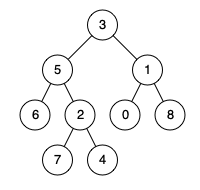
Input: root = [3,5,1,6,2,0,8,null,null,7,4], p = 5, q = 1
Output: 3
Explanation: The LCA of nodes 5 and 1 is 3.
Example 2:
Input: root = [3,5,1,6,2,0,8,null,null,7,4], p = 5, q = 4
Output: 5
Explanation: The LCA of nodes 5 and 4 is 5 since a node can be a descendant of itself according to the LCA definition.
Example 3:
Input: root = [1,2], p = 1, q = 2
Output: 1
Constraints:
- The number of nodes in the tree is in the range
[2, 105].
-109 <= Node.val <= 109- All
Node.val are unique.
p != qp and q exist in the tree.
Solutions
Solution 1: Hash Table
We use a hash table vis to record all nodes on the path from node p to the root node. Then we start from node q and traverse towards the root node. If we encounter a node that exists in the hash table vis, then this node is the nearest common ancestor of p and q, and we can return it directly.
The time complexity is O(n), and the space complexity is O(n). Here, n is the number of nodes in the binary tree.
PythonJavaC++GoTypeScript
"""
# Definition for a Node.
class Node:
def __init__(self, val):
self.val = val
self.left = None
self.right = None
self.parent = None
"""
class Solution:
def lowestCommonAncestor(self, p: "Node", q: "Node") -> "Node":
vis = set()
node = p
while node:
vis.add(node)
node = node.parent
node = q
while node not in vis:
node = node.parent
return node(code-box)
/*
// Definition for a Node.
class Node {
public int val;
public Node left;
public Node right;
public Node parent;
};
*/
class Solution {
public Node lowestCommonAncestor(Node p, Node q) {
Set<Node> vis = new HashSet<>();
for (Node node = p; node != null; node = node.parent) {
vis.add(node);
}
for (Node node = q;; node = node.parent) {
if (!vis.add(node)) {
return node;
}
}
}
}(code-box)
/*
// Definition for a Node.
class Node {
public:
int val;
Node* left;
Node* right;
Node* parent;
};
*/
class Solution {
public:
Node* lowestCommonAncestor(Node* p, Node* q) {
unordered_set<Node*> vis;
for (Node* node = p; node; node = node->parent) {
vis.insert(node);
}
for (Node* node = q;; node = node->parent) {
if (vis.count(node)) {
return node;
}
}
}
};(code-box)
/**
* Definition for Node.
* type Node struct {
* Val int
* Left *Node
* Right *Node
* Parent *Node
* }
*/
func lowestCommonAncestor(p *Node, q *Node) *Node {
vis := map[*Node]bool{}
for node := p; node != nil; node = node.Parent {
vis[node] = true
}
for node := q; ; node = node.Parent {
if vis[node] {
return node
}
}
}(code-box)
/**
* Definition for a binary tree node.
* class Node {
* val: number
* left: Node | null
* right: Node | null
* parent: Node | null
* constructor(val?: number, left?: Node | null, right?: Node | null, parent?: Node | null) {
* this.val = (val===undefined ? 0 : val)
* this.left = (left===undefined ? null : left)
* this.right = (right===undefined ? null : right)
* this.parent = (parent===undefined ? null : parent)
* }
* }
*/
function lowestCommonAncestor(p: Node | null, q: Node | null): Node | null {
const vis: Set<Node> = new Set();
for (let node = p; node; node = node.parent) {
vis.add(node);
}
for (let node = q; ; node = node.parent) {
if (vis.has(node)) {
return node;
}
}
}(code-box)
Solution 2: Two Pointers
We can use two pointers a and b to point to nodes p and q respectively, and then traverse towards the root node. When a and b meet, it is the nearest common ancestor of p and q. Otherwise, if pointer a traverses to the root node, then we let it point to node q, and do the same for pointer b. In this way, when the two pointers meet, it is the nearest common ancestor of p and q.
The time complexity is O(n), where n is the number of nodes in the binary tree. The space complexity is O(1).
PythonJavaC++GoTypeScript
"""
# Definition for a Node.
class Node:
def __init__(self, val):
self.val = val
self.left = None
self.right = None
self.parent = None
"""
class Solution:
def lowestCommonAncestor(self, p: 'Node', q: 'Node') -> 'Node':
a, b = p, q
while a != b:
a = a.parent if a.parent else q
b = b.parent if b.parent else p
return a(code-box)
/*
// Definition for a Node.
class Node {
public int val;
public Node left;
public Node right;
public Node parent;
};
*/
class Solution {
public Node lowestCommonAncestor(Node p, Node q) {
Node a = p, b = q;
while (a != b) {
a = a.parent == null ? q : a.parent;
b = b.parent == null ? p : b.parent;
}
return a;
}
}(code-box)
/*
// Definition for a Node.
class Node {
public:
int val;
Node* left;
Node* right;
Node* parent;
};
*/
class Solution {
public:
Node* lowestCommonAncestor(Node* p, Node* q) {
Node* a = p;
Node* b = q;
while (a != b) {
a = a->parent ? a->parent : q;
b = b->parent ? b->parent : p;
}
return a;
}
};(code-box)
/**
* Definition for Node.
* type Node struct {
* Val int
* Left *Node
* Right *Node
* Parent *Node
* }
*/
func lowestCommonAncestor(p *Node, q *Node) *Node {
a, b := p, q
for a != b {
if a.Parent != nil {
a = a.Parent
} else {
a = q
}
if b.Parent != nil {
b = b.Parent
} else {
b = p
}
}
return a
}(code-box)
/**
* Definition for a binary tree node.
* class Node {
* val: number
* left: Node | null
* right: Node | null
* parent: Node | null
* constructor(val?: number, left?: Node | null, right?: Node | null, parent?: Node | null) {
* this.val = (val===undefined ? 0 : val)
* this.left = (left===undefined ? null : left)
* this.right = (right===undefined ? null : right)
* this.parent = (parent===undefined ? null : parent)
* }
* }
*/
function lowestCommonAncestor(p: Node | null, q: Node | null): Node | null {
let [a, b] = [p, q];
while (a != b) {
a = a.parent ?? q;
b = b.parent ?? p;
}
return a;
}(code-box)


