
Description
A polynomial linked list is a special type of linked list where every node represents a term in a polynomial expression.
Each node has three attributes:
<li><code>coefficient</code>: an integer representing the number multiplier of the term. The coefficient of the term <code><strong>9</strong>x<sup>4</sup></code> is <code>9</code>.</li>

<li><code>power</code>: an integer representing the exponent. The power of the term <code>9x<strong><sup>4</sup></strong></code> is <code>4</code>.</li>

<li><code>next</code>: a pointer to the next node in the list, or <code>null</code> if it is the last node of the list.</li>
For example, the polynomial 5x3 + 4x - 7 is represented by the polynomial linked list illustrated below:

The polynomial linked list must be in its standard form: the polynomial must be in strictly descending order by its power value. Also, terms with a coefficient of 0 are omitted.
Given two polynomial linked list heads, poly1 and poly2, add the polynomials together and return the head of the sum of the polynomials.
PolyNode format:
The input/output format is as a list of n nodes, where each node is represented as its [coefficient, power]. For example, the polynomial 5x3 + 4x - 7 would be represented as: [[5,3],[4,1],[-7,0]].
Example 1:
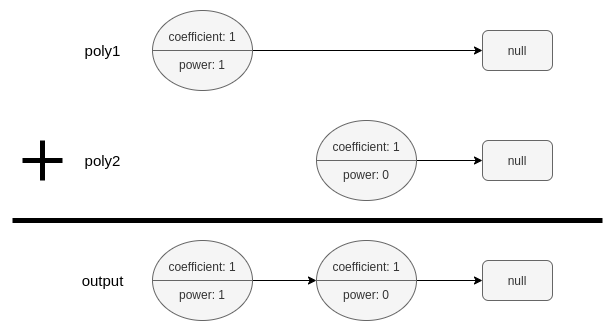
Input: poly1 = [[1,1]], poly2 = [[1,0]]

Output: [[1,1],[1,0]]

Explanation: poly1 = x. poly2 = 1. The sum is x + 1.
Example 2:
Input: poly1 = [[2,2],[4,1],[3,0]], poly2 = [[3,2],[-4,1],[-1,0]]

Output: [[5,2],[2,0]]

Explanation: poly1 = 2x2 + 4x + 3. poly2 = 3x2 - 4x - 1. The sum is 5x2 + 2. Notice that we omit the "0x" term.
Example 3:
Input: poly1 = [[1,2]], poly2 = [[-1,2]]

Output: []

Explanation: The sum is 0. We return an empty list.
Constraints:
<li><code>0 <= n <= 10<sup>4</sup></code></li>
<li><code>-10<sup>9</sup> <= PolyNode.coefficient <= 10<sup>9</sup></code></li>
<li><code>PolyNode.coefficient != 0</code></li>
<li><code>0 <= PolyNode.power <= 10<sup>9</sup></code></li>
<li><code>PolyNode.power > PolyNode.next.power</code></li>
Solutions
Solution 1
PythonJavaC++JavaScriptC#
# Definition for polynomial singly-linked list.
# class PolyNode:
# def __init__(self, x=0, y=0, next=None):
# self.coefficient = x
# self.power = y
# self.next = next
class Solution:
def addPoly(self, poly1: "PolyNode", poly2: "PolyNode") -> "PolyNode":
dummy = curr = PolyNode()
while poly1 and poly2:
if poly1.power > poly2.power:
curr.next = poly1
poly1 = poly1.next
curr = curr.next
elif poly1.power < poly2.power:
curr.next = poly2
poly2 = poly2.next
curr = curr.next
else:
if c := poly1.coefficient + poly2.coefficient:
curr.next = PolyNode(c, poly1.power)
curr = curr.next
poly1 = poly1.next
poly2 = poly2.next
curr.next = poly1 or poly2
return dummy.next(code-box)
/**
* Definition for polynomial singly-linked list.
* class PolyNode {
* int coefficient, power;
* PolyNode next = null;
* PolyNode() {}
* PolyNode(int x, int y) { this.coefficient = x; this.power = y; }
* PolyNode(int x, int y, PolyNode next) { this.coefficient = x; this.power = y; this.next =
next; }
* }
*/
class Solution {
public PolyNode addPoly(PolyNode poly1, PolyNode poly2) {
PolyNode dummy = new PolyNode();
PolyNode curr = dummy;
while (poly1 != null && poly2 != null) {
if (poly1.power > poly2.power) {
curr.next = poly1;
poly1 = poly1.next;
curr = curr.next;
} else if (poly1.power < poly2.power) {
curr.next = poly2;
poly2 = poly2.next;
curr = curr.next;
} else {
int c = poly1.coefficient + poly2.coefficient;
if (c != 0) {
curr.next = new PolyNode(c, poly1.power);
curr = curr.next;
}
poly1 = poly1.next;
poly2 = poly2.next;
}
}
if (poly1 == null) {
curr.next = poly2;
}
if (poly2 == null) {
curr.next = poly1;
}
return dummy.next;
}
}(code-box)
/**
* Definition for polynomial singly-linked list->
* struct PolyNode {
* int coefficient, power;
* PolyNode *next;
* PolyNode(): coefficient(0), power(0), next(nullptr) {};
* PolyNode(int x, int y): coefficient(x), power(y), next(nullptr) {};
* PolyNode(int x, int y, PolyNode* next): coefficient(x), power(y), next(next) {};
* };
*/
class Solution {
public:
PolyNode* addPoly(PolyNode* poly1, PolyNode* poly2) {
PolyNode* dummy = new PolyNode();
PolyNode* curr = dummy;
while (poly1 && poly2) {
if (poly1->power > poly2->power) {
curr->next = poly1;
poly1 = poly1->next;
curr = curr->next;
} else if (poly1->power < poly2->power) {
curr->next = poly2;
poly2 = poly2->next;
curr = curr->next;
} else {
int c = poly1->coefficient + poly2->coefficient;
if (c != 0) {
curr->next = new PolyNode(c, poly1->power);
curr = curr->next;
}
poly1 = poly1->next;
poly2 = poly2->next;
}
}
if (!poly1) {
curr->next = poly2;
}
if (!poly2) {
curr->next = poly1;
}
return dummy->next;
}
};(code-box)
/**
* Definition for polynomial singly-linked list.
* function PolyNode(x=0, y=0, next=null) {
* this.coefficient = x;
* this.power = y;
* this.next = next;
* }
*/
/**
* @param {PolyNode} poly1
* @param {PolyNode} poly2
* @return {PolyNode}
*/
var addPoly = function (poly1, poly2) {
const dummy = new PolyNode();
let curr = dummy;
while (poly1 && poly2) {
if (poly1.power > poly2.power) {
curr.next = poly1;
poly1 = poly1.next;
curr = curr.next;
} else if (poly1.power < poly2.power) {
curr.next = poly2;
poly2 = poly2.next;
curr = curr.next;
} else {
const c = poly1.coefficient + poly2.coefficient;
if (c != 0) {
curr.next = new PolyNode(c, poly1.power);
curr = curr.next;
}
poly1 = poly1.next;
poly2 = poly2.next;
}
}
curr.next = poly1 || poly2;
return dummy.next;
};(code-box)
/**
* Definition for polynomial singly-linked list.
* public class PolyNode {
* public int coefficient, power;
* public PolyNode next;
*
* public PolyNode(int x=0, int y=0, PolyNode next=null) {
* this.coefficient = x;
* this.power = y;
* this.next = next;
* }
* }
*/
public class Solution {
public PolyNode AddPoly(PolyNode poly1, PolyNode poly2) {
PolyNode dummy = new PolyNode();
PolyNode curr = dummy;
while (poly1 != null && poly2 != null) {
if (poly1.power > poly2.power) {
curr.next = poly1;
poly1 = poly1.next;
curr = curr.next;
} else if (poly1.power < poly2.power) {
curr.next = poly2;
poly2 = poly2.next;
curr = curr.next;
} else {
int c = poly1.coefficient + poly2.coefficient;
if (c != 0) {
curr.next = new PolyNode(c, poly1.power);
curr = curr.next;
}
poly1 = poly1.next;
poly2 = poly2.next;
}
}
if (poly1 == null) {
curr.next = poly2;
}
if (poly2 == null) {
curr.next = poly1;
}
return dummy.next;
}
}(code-box)


