


Description
We have n cities labeled from 1 to n. Two different cities with labels x and y are directly connected by a bidirectional road if and only if x and y share a common divisor strictly greater than some threshold. More formally, cities with labels x and y have a road between them if there exists an integer z such that all of the following are true:
x % z == 0,y % z == 0, andz > threshold.
Given the two integers, n and threshold, and an array of queries, you must determine for each queries[i] = [ai, bi] if cities ai and bi are connected directly or indirectly. (i.e. there is some path between them).
Return an array answer, where answer.length == queries.length and answer[i] is true if for the ith query, there is a path between ai and bi, or answer[i] is false if there is no path.
Example 1:
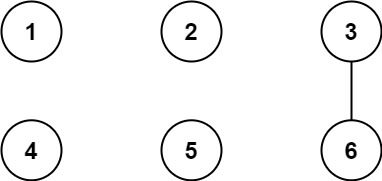
Input: n = 6, threshold = 2, queries = [[1,4],[2,5],[3,6]]
Output: [false,false,true]
Explanation: The divisors for each number:
1:   1
2:   1, 2
3:   1, 3
4:   1, 2, 4
5:   1, 5
6:   1, 2, 3, 6
Using the underlined divisors above the threshold, only cities 3 and 6 share a common divisor, so they are the
only ones directly connected. The result of each query:
[1,4]   1 is not connected to 4
[2,5]   2 is not connected to 5
[3,6]   3 is connected to 6 through path 3--6
Example 2:
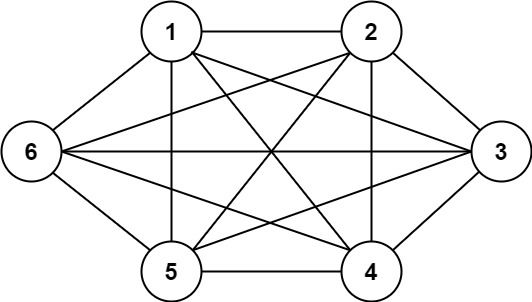
Input: n = 6, threshold = 0, queries = [[4,5],[3,4],[3,2],[2,6],[1,3]]
Output: [true,true,true,true,true]
Explanation: The divisors for each number are the same as the previous example. However, since the threshold is 0,
all divisors can be used. Since all numbers share 1 as a divisor, all cities are connected.
Example 3:
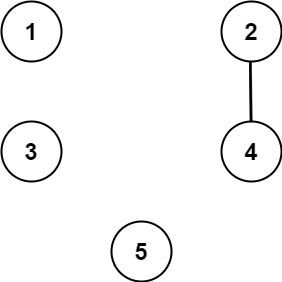
Input: n = 5, threshold = 1, queries = [[4,5],[4,5],[3,2],[2,3],[3,4]]
Output: [false,false,false,false,false]
Explanation: Only cities 2 and 4 share a common divisor 2 which is strictly greater than the threshold 1, so they are the only ones directly connected.
Please notice that there can be multiple queries for the same pair of nodes [x, y], and that the query [x, y] is equivalent to the query [y, x].
Constraints:
2 <= n <= 1040 <= threshold <= n1 <= queries.length <= 105queries[i].length == 21 <= ai, bi <= citiesai != bi
Solutions
Solution 1: Union-Find
We can enumerate z and its multiples, and use union-find to connect them. In this way, for each query [a, b], we only need to determine whether a and b are in the same connected component.
The time complexity is O(n × log n × (α(n) + q)), and the space complexity is O(n). Here, n and q are the number of nodes and queries, respectively, and α is the inverse function of the Ackermann function.
class UnionFind: def __init__(self, n): self.p = list(range(n)) self.size = [1] * n def find(self, x): if self.p[x] != x: self.p[x] = self.find(self.p[x]) return self.p[x] def union(self, a, b): pa, pb = self.find(a), self.find(b) if pa == pb: return False if self.size[pa] > self.size[pb]: self.p[pb] = pa self.size[pa] += self.size[pb] else: self.p[pa] = pb self.size[pb] += self.size[pa] return True class Solution: def areConnected( self, n: int, threshold: int, queries: List[List[int]] ) -> List[bool]: uf = UnionFind(n + 1) for a in range(threshold + 1, n + 1): for b in range(a + a, n + 1, a): uf.union(a, b) return [uf.find(a) == uf.find(b) for a, b in queries](code-box)
