
Description
Given an m x n binary matrix mat, return the number of submatrices that have all ones.
Example 1:
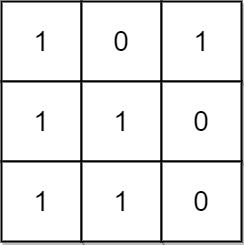
Input: mat = [[1,0,1],[1,1,0],[1,1,0]]
Output: 13
Explanation:
There are 6 rectangles of side 1x1.
There are 2 rectangles of side 1x2.
There are 3 rectangles of side 2x1.
There is 1 rectangle of side 2x2.
There is 1 rectangle of side 3x1.
Total number of rectangles = 6 + 2 + 3 + 1 + 1 = 13.
Example 2:
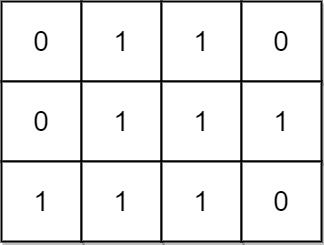
Input: mat = [[0,1,1,0],[0,1,1,1],[1,1,1,0]]
Output: 24
Explanation:
There are 8 rectangles of side 1x1.
There are 5 rectangles of side 1x2.
There are 2 rectangles of side 1x3.
There are 4 rectangles of side 2x1.
There are 2 rectangles of side 2x2.
There are 2 rectangles of side 3x1.
There is 1 rectangle of side 3x2.
Total number of rectangles = 8 + 5 + 2 + 4 + 2 + 2 + 1 = 24.
Constraints:
1 <= m, n <= 150mat[i][j] is either 0 or 1.
Solutions
Solution 1: Enumeration + Prefix Sum
We can enumerate the bottom-right corner (i, j) of the matrix, and then enumerate the first row k upwards. The width of the matrix with (i, j) as the bottom-right corner in each row is min_{k ≤ i} g[k][j], where g[k][j] represents the width of the matrix with (k, j) as the bottom-right corner in the k-th row.
Therefore, we can preprocess a 2D array g[i][j], where g[i][j] represents the number of consecutive 1s from the j-th column to the left in the i-th row.
The time complexity is O(m2 × n), and the space complexity is O(m × n). Here, m and n are the number of rows and columns of the matrix, respectively.
PythonJavaC++GoTypeScriptRustJavaScript
class Solution:
def numSubmat(self, mat: List[List[int]]) -> int:
m, n = len(mat), len(mat[0])
g = [[0] * n for _ in range(m)]
for i in range(m):
for j in range(n):
if mat[i][j]:
g[i][j] = 1 if j == 0 else 1 + g[i][j - 1]
ans = 0
for i in range(m):
for j in range(n):
col = inf
for k in range(i, -1, -1):
col = min(col, g[k][j])
ans += col
return ans(code-box)
class Solution {
public int numSubmat(int[][] mat) {
int m = mat.length, n = mat[0].length;
int[][] g = new int[m][n];
for (int i = 0; i < m; ++i) {
for (int j = 0; j < n; ++j) {
if (mat[i][j] == 1) {
g[i][j] = j == 0 ? 1 : 1 + g[i][j - 1];
}
}
}
int ans = 0;
for (int i = 0; i < m; ++i) {
for (int j = 0; j < n; ++j) {
int col = 1 << 30;
for (int k = i; k >= 0 && col > 0; --k) {
col = Math.min(col, g[k][j]);
ans += col;
}
}
}
return ans;
}
}(code-box)
class Solution {
public:
int numSubmat(vector<vector<int>>& mat) {
int m = mat.size(), n = mat[0].size();
vector<vector<int>> g(m, vector<int>(n));
for (int i = 0; i < m; ++i) {
for (int j = 0; j < n; ++j) {
if (mat[i][j] == 1) {
g[i][j] = j == 0 ? 1 : 1 + g[i][j - 1];
}
}
}
int ans = 0;
for (int i = 0; i < m; ++i) {
for (int j = 0; j < n; ++j) {
int col = 1 << 30;
for (int k = i; k >= 0 && col > 0; --k) {
col = min(col, g[k][j]);
ans += col;
}
}
}
return ans;
}
};(code-box)
func numSubmat(mat [][]int) (ans int) {
m, n := len(mat), len(mat[0])
g := make([][]int, m)
for i := range g {
g[i] = make([]int, n)
for j := range g[i] {
if mat[i][j] == 1 {
if j == 0 {
g[i][j] = 1
} else {
g[i][j] = 1 + g[i][j-1]
}
}
}
}
for i := range g {
for j := range g[i] {
col := 1 << 30
for k := i; k >= 0 && col > 0; k-- {
col = min(col, g[k][j])
ans += col
}
}
}
return
}(code-box)
function numSubmat(mat: number[][]): number {
const m = mat.length;
const n = mat[0].length;
const g: number[][] = Array.from({ length: m }, () => Array(n).fill(0));
for (let i = 0; i < m; i++) {
for (let j = 0; j < n; j++) {
if (mat[i][j]) {
g[i][j] = j === 0 ? 1 : 1 + g[i][j - 1];
}
}
}
let ans = 0;
for (let i = 0; i < m; i++) {
for (let j = 0; j < n; j++) {
let col = Infinity;
for (let k = i; k >= 0; k--) {
col = Math.min(col, g[k][j]);
ans += col;
}
}
}
return ans;
}(code-box)
impl Solution {
pub fn num_submat(mat: Vec<Vec<i32>>) -> i32 {
let m = mat.len();
let n = mat[0].len();
let mut g = vec![vec![0; n]; m];
for i in 0..m {
for j in 0..n {
if mat[i][j] == 1 {
if j == 0 {
g[i][j] = 1;
} else {
g[i][j] = 1 + g[i][j - 1];
}
}
}
}
let mut ans = 0;
for i in 0..m {
for j in 0..n {
let mut col = i32::MAX;
let mut k = i as i32;
while k >= 0 && col > 0 {
col = col.min(g[k as usize][j]);
ans += col;
k -= 1;
}
}
}
ans
}
}(code-box)
/**
* @param {number[][]} mat
* @return {number}
*/
var numSubmat = function (mat) {
const m = mat.length;
const n = mat[0].length;
const g = Array.from({ length: m }, () => Array(n).fill(0));
for (let i = 0; i < m; i++) {
for (let j = 0; j < n; j++) {
if (mat[i][j]) {
g[i][j] = j === 0 ? 1 : 1 + g[i][j - 1];
}
}
}
let ans = 0;
for (let i = 0; i < m; i++) {
for (let j = 0; j < n; j++) {
let col = Infinity;
for (let k = i; k >= 0; k--) {
col = Math.min(col, g[k][j]);
ans += col;
}
}
}
return ans;
};(code-box)


