
Description
For a binary tree T, we can define a flip operation as follows: choose any node, and swap the left and right child subtrees.
A binary tree X is flip equivalent to a binary tree Y if and only if we can make X equal to Y after some number of flip operations.
Given the roots of two binary trees root1 and root2, return true if the two trees are flip equivalent or false otherwise.
Example 1:
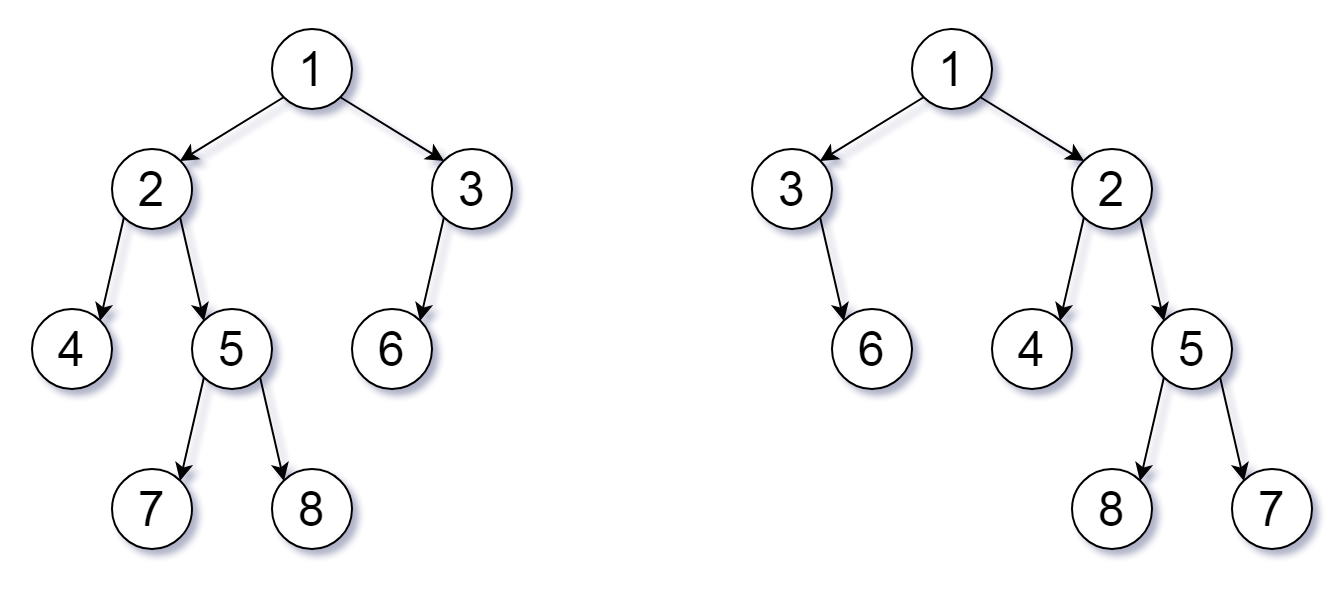
Input: root1 = [1,2,3,4,5,6,null,null,null,7,8], root2 = [1,3,2,null,6,4,5,null,null,null,null,8,7]
Output: true
Explanation: We flipped at nodes with values 1, 3, and 5.
Example 2:
Input: root1 = [], root2 = []
Output: true
Example 3:
Input: root1 = [], root2 = [1]
Output: false
Constraints:
- The number of nodes in each tree is in the range
[0, 100].
- Each tree will have unique node values in the range
[0, 99].
Solutions
Solution 1
PythonJavaC++GoTypeScriptJavaScript
# Definition for a binary tree node.
# class TreeNode:
# def __init__(self, val=0, left=None, right=None):
# self.val = val
# self.left = left
# self.right = right
class Solution:
def flipEquiv(self, root1: Optional[TreeNode], root2: Optional[TreeNode]) -> bool:
def dfs(root1, root2):
if root1 == root2 or (root1 is None and root2 is None):
return True
if root1 is None or root2 is None or root1.val != root2.val:
return False
return (dfs(root1.left, root2.left) and dfs(root1.right, root2.right)) or (
dfs(root1.left, root2.right) and dfs(root1.right, root2.left)
)
return dfs(root1, root2)(code-box)
/**
* Definition for a binary tree node.
* public class TreeNode {
* int val;
* TreeNode left;
* TreeNode right;
* TreeNode() {}
* TreeNode(int val) { this.val = val; }
* TreeNode(int val, TreeNode left, TreeNode right) {
* this.val = val;
* this.left = left;
* this.right = right;
* }
* }
*/
class Solution {
public boolean flipEquiv(TreeNode root1, TreeNode root2) {
return dfs(root1, root2);
}
private boolean dfs(TreeNode root1, TreeNode root2) {
if (root1 == root2 || (root1 == null && root2 == null)) {
return true;
}
if (root1 == null || root2 == null || root1.val != root2.val) {
return false;
}
return (dfs(root1.left, root2.left) && dfs(root1.right, root2.right))
|| (dfs(root1.left, root2.right) && dfs(root1.right, root2.left));
}
}(code-box)
/**
* Definition for a binary tree node.
* struct TreeNode {
* int val;
* TreeNode *left;
* TreeNode *right;
* TreeNode() : val(0), left(nullptr), right(nullptr) {}
* TreeNode(int x) : val(x), left(nullptr), right(nullptr) {}
* TreeNode(int x, TreeNode *left, TreeNode *right) : val(x), left(left), right(right) {}
* };
*/
class Solution {
public:
bool flipEquiv(TreeNode* root1, TreeNode* root2) {
return dfs(root1, root2);
}
bool dfs(TreeNode* root1, TreeNode* root2) {
if (root1 == root2 || (!root1 && !root2)) return true;
if (!root1 || !root2 || root1->val != root2->val) return false;
return (dfs(root1->left, root2->left) && dfs(root1->right, root2->right)) || (dfs(root1->left, root2->right) && dfs(root1->right, root2->left));
}
};(code-box)
/**
* Definition for a binary tree node.
* type TreeNode struct {
* Val int
* Left *TreeNode
* Right *TreeNode
* }
*/
func flipEquiv(root1 *TreeNode, root2 *TreeNode) bool {
var dfs func(root1, root2 *TreeNode) bool
dfs = func(root1, root2 *TreeNode) bool {
if root1 == root2 || (root1 == nil && root2 == nil) {
return true
}
if root1 == nil || root2 == nil || root1.Val != root2.Val {
return false
}
return (dfs(root1.Left, root2.Left) && dfs(root1.Right, root2.Right)) || (dfs(root1.Left, root2.Right) && dfs(root1.Right, root2.Left))
}
return dfs(root1, root2)
}(code-box)
function flipEquiv(root1: TreeNode | null, root2: TreeNode | null): boolean {
if (root1 === root2) return true;
if (!root1 || !root2 || root1?.val !== root2?.val) return false;
const { left: l1, right: r1 } = root1!;
const { left: l2, right: r2 } = root2!;
return (flipEquiv(l1, l2) && flipEquiv(r1, r2)) || (flipEquiv(l1, r2) && flipEquiv(r1, l2));
}(code-box)
function flipEquiv(root1, root2) {
if (root1 === root2) return true;
if (!root1 || !root2 || root1?.val !== root2?.val) return false;
const { left: l1, right: r1 } = root1;
const { left: l2, right: r2 } = root2;
return (flipEquiv(l1, l2) && flipEquiv(r1, r2)) || (flipEquiv(l1, r2) && flipEquiv(r1, l2));
}(code-box)


