
Description
A complete binary tree is a binary tree in which every level, except possibly the last, is completely filled, and all nodes are as far left as possible.
Design an algorithm to insert a new node to a complete binary tree keeping it complete after the insertion.
Implement the CBTInserter class:
CBTInserter(TreeNode root) Initializes the data structure with the root of the complete binary tree.int insert(int v) Inserts a TreeNode into the tree with value Node.val == val so that the tree remains complete, and returns the value of the parent of the inserted TreeNode.TreeNode get_root() Returns the root node of the tree.
Example 1:
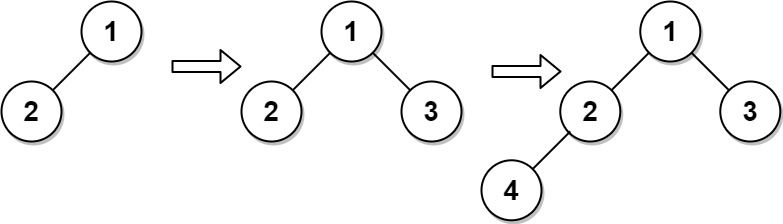
Input
["CBTInserter", "insert", "insert", "get_root"]
[[[1, 2]], [3], [4], []]
Output
[null, 1, 2, [1, 2, 3, 4]]

Explanation
CBTInserter cBTInserter = new CBTInserter([1, 2]);
cBTInserter.insert(3); // return 1
cBTInserter.insert(4); // return 2
cBTInserter.get_root(); // return [1, 2, 3, 4]
Constraints:
- The number of nodes in the tree will be in the range
[1, 1000].
0 <= Node.val <= 5000root is a complete binary tree.0 <= val <= 5000- At most
104 calls will be made to insert and get_root.
Solutions
Solution 1: BFS
We can use an array tree to store all nodes of the complete binary tree. During initialization, we use a queue q to perform level-order traversal of the given tree and store all nodes into the array tree.
When inserting a node, we can find the parent node p of the new node through the array tree. Then we create a new node node, insert it into the array tree, and make node as the left child or right child of p. Finally, we return the value of p.
When getting the root node, we directly return the first element of the array tree.
In terms of time complexity, it takes O(n) time for initialization, and the time complexity for inserting a node and getting the root node are both O(1). The space complexity is O(n), where n is the number of nodes in the tree.
PythonJavaC++GoTypeScriptJavaScript
# Definition for a binary tree node.
# class TreeNode:
# def __init__(self, val=0, left=None, right=None):
# self.val = val
# self.left = left
# self.right = right
class CBTInserter:
def __init__(self, root: Optional[TreeNode]):
self.tree = []
q = deque([root])
while q:
for _ in range(len(q)):
node = q.popleft()
self.tree.append(node)
if node.left:
q.append(node.left)
if node.right:
q.append(node.right)
def insert(self, val: int) -> int:
p = self.tree[(len(self.tree) - 1) // 2]
node = TreeNode(val)
self.tree.append(node)
if p.left is None:
p.left = node
else:
p.right = node
return p.val
def get_root(self) -> Optional[TreeNode]:
return self.tree[0]
# Your CBTInserter object will be instantiated and called as such:
# obj = CBTInserter(root)
# param_1 = obj.insert(val)
# param_2 = obj.get_root()(code-box)
/**
* Definition for a binary tree node.
* public class TreeNode {
* int val;
* TreeNode left;
* TreeNode right;
* TreeNode() {}
* TreeNode(int val) { this.val = val; }
* TreeNode(int val, TreeNode left, TreeNode right) {
* this.val = val;
* this.left = left;
* this.right = right;
* }
* }
*/
class CBTInserter {
private List<TreeNode> tree = new ArrayList<>();
public CBTInserter(TreeNode root) {
Deque<TreeNode> q = new ArrayDeque<>();
q.offer(root);
while (!q.isEmpty()) {
for (int i = q.size(); i > 0; --i) {
TreeNode node = q.poll();
tree.add(node);
if (node.left != null) {
q.offer(node.left);
}
if (node.right != null) {
q.offer(node.right);
}
}
}
}
public int insert(int val) {
TreeNode p = tree.get((tree.size() - 1) / 2);
TreeNode node = new TreeNode(val);
tree.add(node);
if (p.left == null) {
p.left = node;
} else {
p.right = node;
}
return p.val;
}
public TreeNode get_root() {
return tree.get(0);
}
}
/**
* Your CBTInserter object will be instantiated and called as such:
* CBTInserter obj = new CBTInserter(root);
* int param_1 = obj.insert(val);
* TreeNode param_2 = obj.get_root();
*/(code-box)
/**
* Definition for a binary tree node.
* struct TreeNode {
* int val;
* TreeNode *left;
* TreeNode *right;
* TreeNode() : val(0), left(nullptr), right(nullptr) {}
* TreeNode(int x) : val(x), left(nullptr), right(nullptr) {}
* TreeNode(int x, TreeNode *left, TreeNode *right) : val(x), left(left), right(right) {}
* };
*/
class CBTInserter {
public:
CBTInserter(TreeNode* root) {
queue<TreeNode*> q{{root}};
while (q.size()) {
for (int i = q.size(); i; --i) {
auto node = q.front();
q.pop();
tree.push_back(node);
if (node->left) {
q.push(node->left);
}
if (node->right) {
q.push(node->right);
}
}
}
}
int insert(int val) {
auto p = tree[(tree.size() - 1) / 2];
auto node = new TreeNode(val);
tree.push_back(node);
if (!p->left) {
p->left = node;
} else {
p->right = node;
}
return p->val;
}
TreeNode* get_root() {
return tree[0];
}
private:
vector<TreeNode*> tree;
};
/**
* Your CBTInserter object will be instantiated and called as such:
* CBTInserter* obj = new CBTInserter(root);
* int param_1 = obj->insert(val);
* TreeNode* param_2 = obj->get_root();
*/(code-box)
/**
* Definition for a binary tree node.
* type TreeNode struct {
* Val int
* Left *TreeNode
* Right *TreeNode
* }
*/
type CBTInserter struct {
tree []*TreeNode
}
func Constructor(root *TreeNode) CBTInserter {
q := []*TreeNode{root}
tree := []*TreeNode{}
for len(q) > 0 {
for i := len(q); i > 0; i-- {
node := q[0]
q = q[1:]
tree = append(tree, node)
if node.Left != nil {
q = append(q, node.Left)
}
if node.Right != nil {
q = append(q, node.Right)
}
}
}
return CBTInserter{tree}
}
func (this *CBTInserter) Insert(val int) int {
p := this.tree[(len(this.tree)-1)/2]
node := &TreeNode{val, nil, nil}
this.tree = append(this.tree, node)
if p.Left == nil {
p.Left = node
} else {
p.Right = node
}
return p.Val
}
func (this *CBTInserter) Get_root() *TreeNode {
return this.tree[0]
}
/**
* Your CBTInserter object will be instantiated and called as such:
* obj := Constructor(root);
* param_1 := obj.Insert(val);
* param_2 := obj.Get_root();
*/(code-box)
/**
* Definition for a binary tree node.
* class TreeNode {
* val: number
* left: TreeNode | null
* right: TreeNode | null
* constructor(val?: number, left?: TreeNode | null, right?: TreeNode | null) {
* this.val = (val===undefined ? 0 : val)
* this.left = (left===undefined ? null : left)
* this.right = (right===undefined ? null : right)
* }
* }
*/
class CBTInserter {
private tree: TreeNode[] = [];
constructor(root: TreeNode | null) {
if (root === null) {
return;
}
const q: TreeNode[] = [root];
while (q.length) {
const t: TreeNode[] = [];
for (const node of q) {
this.tree.push(node);
node.left !== null && t.push(node.left);
node.right !== null && t.push(node.right);
}
q.splice(0, q.length, ...t);
}
}
insert(val: number): number {
const p = this.tree[(this.tree.length - 1) >> 1];
const node = new TreeNode(val);
this.tree.push(node);
if (p.left === null) {
p.left = node;
} else {
p.right = node;
}
return p.val;
}
get_root(): TreeNode | null {
return this.tree[0];
}
}
/**
* Your CBTInserter object will be instantiated and called as such:
* var obj = new CBTInserter(root)
* var param_1 = obj.insert(val)
* var param_2 = obj.get_root()
*/(code-box)
/**
* Definition for a binary tree node.
* function TreeNode(val, left, right) {
* this.val = (val===undefined ? 0 : val)
* this.left = (left===undefined ? null : left)
* this.right = (right===undefined ? null : right)
* }
*/
/**
* @param {TreeNode} root
*/
var CBTInserter = function (root) {
this.tree = [];
if (root === null) {
return;
}
const q = [root];
while (q.length) {
const t = [];
for (const node of q) {
this.tree.push(node);
node.left !== null && t.push(node.left);
node.right !== null && t.push(node.right);
}
q.splice(0, q.length, ...t);
}
};
/**
* @param {number} val
* @return {number}
*/
CBTInserter.prototype.insert = function (val) {
const p = this.tree[(this.tree.length - 1) >> 1];
const node = new TreeNode(val);
this.tree.push(node);
if (p.left === null) {
p.left = node;
} else {
p.right = node;
}
return p.val;
};
/**
* @return {TreeNode}
*/
CBTInserter.prototype.get_root = function () {
return this.tree[0];
};
/**
* Your CBTInserter object will be instantiated and called as such:
* var obj = new CBTInserter(root)
* var param_1 = obj.insert(val)
* var param_2 = obj.get_root()
*/(code-box)


