
Description
Consider all the leaves of a binary tree, from left to right order, the values of those leaves form a leaf value sequence.
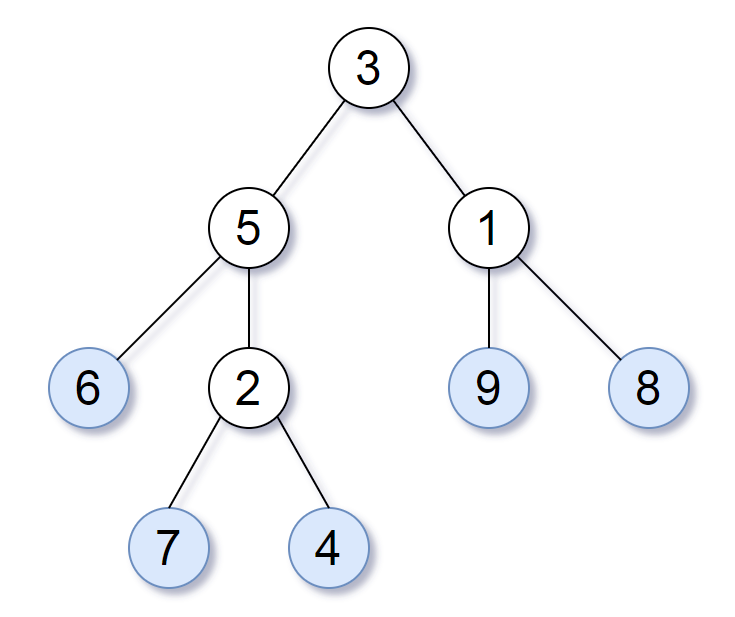
For example, in the given tree above, the leaf value sequence is (6, 7, 4, 9, 8).
Two binary trees are considered leaf-similar if their leaf value sequence is the same.
Return true if and only if the two given trees with head nodes root1 and root2 are leaf-similar.
Example 1:
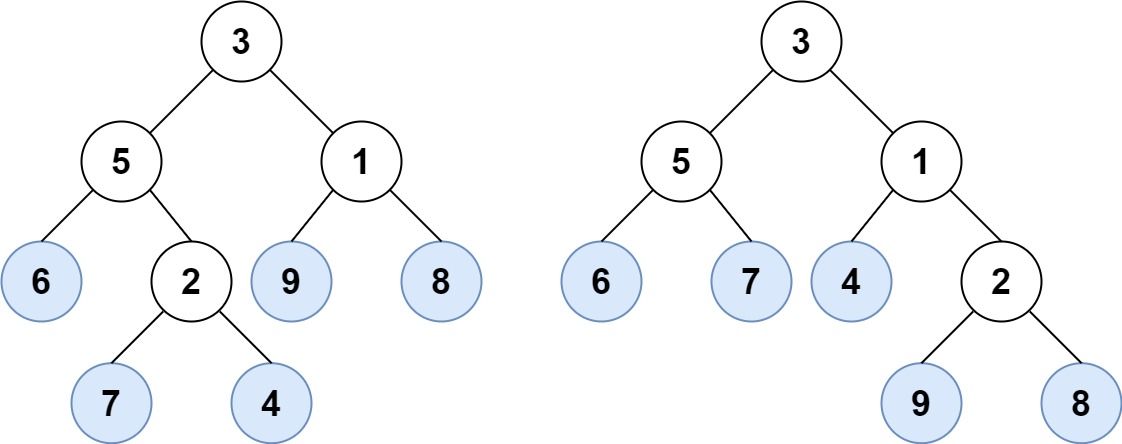
Input: root1 = [3,5,1,6,2,9,8,null,null,7,4], root2 = [3,5,1,6,7,4,2,null,null,null,null,null,null,9,8]
Output: true
Example 2:
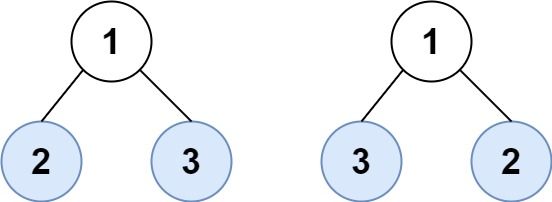
Input: root1 = [1,2,3], root2 = [1,3,2]
Output: false
Constraints:
- The number of nodes in each tree will be in the range
[1, 200].
- Both of the given trees will have values in the range
[0, 200].
Solutions
Solution 1: DFS
We can use Depth-First Search (DFS) to traverse the leaf nodes of the two trees, storing the values of the leaf nodes in two lists l1 and l2 respectively. Finally, we compare whether the two lists are equal.
Time complexity is O(n), and space complexity is O(n). Here, n is the number of nodes in the tree.
PythonJavaC++GoRustJavaScript
# Definition for a binary tree node.
# class TreeNode:
# def __init__(self, val=0, left=None, right=None):
# self.val = val
# self.left = left
# self.right = right
class Solution:
def leafSimilar(self, root1: Optional[TreeNode], root2: Optional[TreeNode]) -> bool:
def dfs(root: Optional[TreeNode], nums: List[int]) -> None:
if root.left == root.right:
nums.append(root.val)
return
if root.left:
dfs(root.left, nums)
if root.right:
dfs(root.right, nums)
l1, l2 = [], []
dfs(root1, l1)
dfs(root2, l2)
return l1 == l2(code-box)
/**
* Definition for a binary tree node.
* public class TreeNode {
* int val;
* TreeNode left;
* TreeNode right;
* TreeNode() {}
* TreeNode(int val) { this.val = val; }
* TreeNode(int val, TreeNode left, TreeNode right) {
* this.val = val;
* this.left = left;
* this.right = right;
* }
* }
*/
class Solution {
public boolean leafSimilar(TreeNode root1, TreeNode root2) {
List<Integer> l1 = new ArrayList<>();
List<Integer> l2 = new ArrayList<>();
dfs(root1, l1);
dfs(root2, l2);
return l1.equals(l2);
}
private void dfs(TreeNode root, List<Integer> nums) {
if (root.left == root.right) {
nums.add(root.val);
return;
}
if (root.left != null) {
dfs(root.left, nums);
}
if (root.right != null) {
dfs(root.right, nums);
}
}
}(code-box)
/**
* Definition for a binary tree node.
* struct TreeNode {
* int val;
* TreeNode *left;
* TreeNode *right;
* TreeNode() : val(0), left(nullptr), right(nullptr) {}
* TreeNode(int x) : val(x), left(nullptr), right(nullptr) {}
* TreeNode(int x, TreeNode *left, TreeNode *right) : val(x), left(left), right(right) {}
* };
*/
class Solution {
public:
bool leafSimilar(TreeNode* root1, TreeNode* root2) {
vector<int> l1, l2;
dfs(root1, l1);
dfs(root2, l2);
return l1 == l2;
}
void dfs(TreeNode* root, vector<int>& nums) {
if (root->left == root->right) {
nums.push_back(root->val);
return;
}
if (root->left) {
dfs(root->left, nums);
}
if (root->right) {
dfs(root->right, nums);
}
}
};(code-box)
/**
* Definition for a binary tree node.
* type TreeNode struct {
* Val int
* Left *TreeNode
* Right *TreeNode
* }
*/
func leafSimilar(root1 *TreeNode, root2 *TreeNode) bool {
l1, l2 := []int{}, []int{}
var dfs func(*TreeNode, *[]int)
dfs = func(root *TreeNode, nums *[]int) {
if root.Left == root.Right {
*nums = append(*nums, root.Val)
return
}
if root.Left != nil {
dfs(root.Left, nums)
}
if root.Right != nil {
dfs(root.Right, nums)
}
}
dfs(root1, &l1)
dfs(root2, &l2)
return reflect.DeepEqual(l1, l2)
}(code-box)
// Definition for a binary tree node.
// #[derive(Debug, PartialEq, Eq)]
// pub struct TreeNode {
// pub val: i32,
// pub left: Option<Rc<RefCell<TreeNode>>>,
// pub right: Option<Rc<RefCell<TreeNode>>>,
// }
//
// impl TreeNode {
// #[inline]
// pub fn new(val: i32) -> Self {
// TreeNode {
// val,
// left: None,
// right: None
// }
// }
// }
use std::cell::RefCell;
use std::rc::Rc;
impl Solution {
pub fn leaf_similar(
root1: Option<Rc<RefCell<TreeNode>>>,
root2: Option<Rc<RefCell<TreeNode>>>,
) -> bool {
let mut l1 = Vec::new();
let mut l2 = Vec::new();
Self::dfs(&root1, &mut l1);
Self::dfs(&root2, &mut l2);
l1 == l2
}
fn dfs(node: &Option<Rc<RefCell<TreeNode>>>, nums: &mut Vec<i32>) {
if let Some(n) = node {
let n = n.borrow();
if n.left.is_none() && n.right.is_none() {
nums.push(n.val);
return;
}
if n.left.is_some() {
Self::dfs(&n.left, nums);
}
if n.right.is_some() {
Self::dfs(&n.right, nums);
}
}
}
}(code-box)
var leafSimilar = function (root1, root2) {
const l1 = [];
const l2 = [];
const dfs = (root, nums) => {
if (root.left === root.right) {
nums.push(root.val);
return;
}
root.left && dfs(root.left, nums);
root.right && dfs(root.right, nums);
};
dfs(root1, l1);
dfs(root2, l2);
return l1.join(',') === l2.join(',');
};(code-box)


