
Description
Given a 2D integer array matrix, return the transpose of matrix.
The transpose of a matrix is the matrix flipped over its main diagonal, switching the matrix's row and column indices.
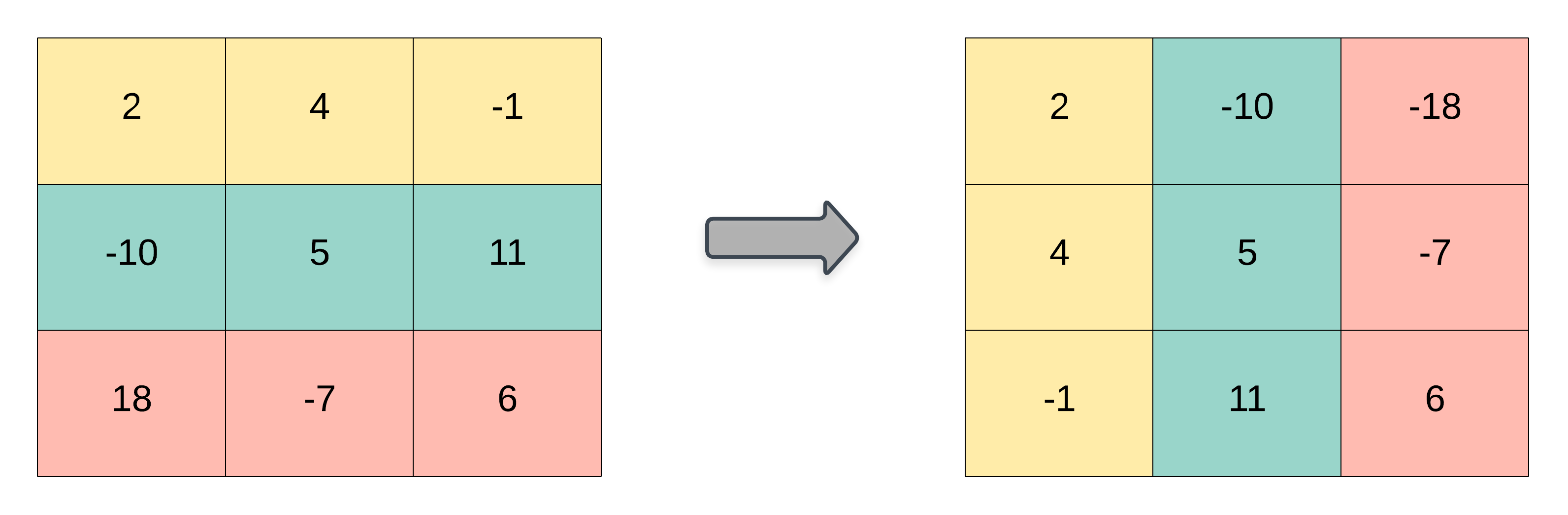
Example 1:
Input: matrix = [[1,2,3],[4,5,6],[7,8,9]]
Output: [[1,4,7],[2,5,8],[3,6,9]]
Example 2:
Input: matrix = [[1,2,3],[4,5,6]]
Output: [[1,4],[2,5],[3,6]]
Constraints:
m == matrix.lengthn == matrix[i].length1 <= m, n <= 10001 <= m * n <= 105-109 <= matrix[i][j] <= 109
Solutions
Solution 1: Simulation
Let m be the number of rows and n be the number of columns in the matrix matrix. According to the definition of transpose, the transposed matrix ans will have n rows and m columns.
For any position (i, j) in ans, it corresponds to the position (j, i) in the matrix matrix. Therefore, we traverse each element in the matrix matrix and transpose it to the corresponding position in ans.
After the traversal, we return ans.
The time complexity is O(m × n), where m and n are the number of rows and columns in the matrix matrix, respectively. Ignoring the space consumption of the answer, the space complexity is O(1).
PythonJavaC++GoTypeScriptJavaScript
class Solution:
def transpose(self, matrix: List[List[int]]) -> List[List[int]]:
return list(zip(*matrix))(code-box)
class Solution {
public int[][] transpose(int[][] matrix) {
int m = matrix.length, n = matrix[0].length;
int[][] ans = new int[n][m];
for (int i = 0; i < n; ++i) {
for (int j = 0; j < m; ++j) {
ans[i][j] = matrix[j][i];
}
}
return ans;
}
}(code-box)
class Solution {
public:
vector<vector<int>> transpose(vector<vector<int>>& matrix) {
int m = matrix.size(), n = matrix[0].size();
vector<vector<int>> ans(n, vector<int>(m));
for (int i = 0; i < n; ++i) {
for (int j = 0; j < m; ++j) {
ans[i][j] = matrix[j][i];
}
}
return ans;
}
};(code-box)
func transpose(matrix [][]int) [][]int {
m, n := len(matrix), len(matrix[0])
ans := make([][]int, n)
for i := range ans {
ans[i] = make([]int, m)
for j := range ans[i] {
ans[i][j] = matrix[j][i]
}
}
return ans
}(code-box)
function transpose(matrix: number[][]): number[][] {
const [m, n] = [matrix.length, matrix[0].length];
const ans: number[][] = Array.from({ length: n }, () => Array(m).fill(0));
for (let i = 0; i < n; ++i) {
for (let j = 0; j < m; ++j) {
ans[i][j] = matrix[j][i];
}
}
return ans;
}(code-box)
/**
* @param {number[][]} matrix
* @return {number[][]}
*/
var transpose = function (matrix) {
const [m, n] = [matrix.length, matrix[0].length];
const ans = Array.from({ length: n }, () => Array(m).fill(0));
for (let i = 0; i < n; ++i) {
for (let j = 0; j < m; ++j) {
ans[i][j] = matrix[j][i];
}
}
return ans;
};(code-box)


