


Description
You have two types of tiles: a 2 x 1 domino shape and a tromino shape. You may rotate these shapes.
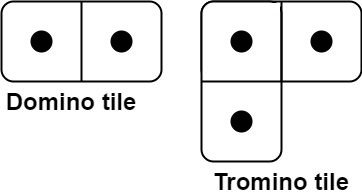
Given an integer n, return the number of ways to tile an 2 x n board. Since the answer may be very large, return it modulo 109 + 7.
In a tiling, every square must be covered by a tile. Two tilings are different if and only if there are two 4-directionally adjacent cells on the board such that exactly one of the tilings has both squares occupied by a tile.
Example 1:
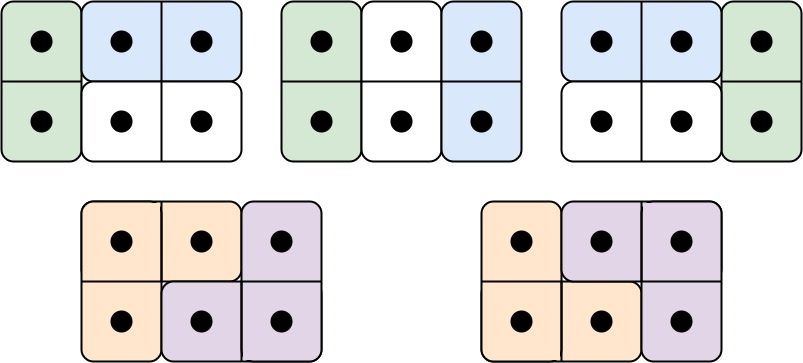
Input: n = 3
Output: 5
Explanation: The five different ways are shown above.
Example 2:
Input: n = 1
Output: 1
Constraints:
1 <= n <= 1000
Solutions
Solution 1: Dynamic Programming
First, we need to understand the problem. The problem is essentially asking us to find the number of ways to tile a 2 × n board, where each square on the board can only be covered by one tile.
There are two types of tiles: 2 x 1 and L shapes, and both types of tiles can be rotated. We denote the rotated tiles as 1 x 2 and L' shapes.
We define f[i][j] to represent the number of ways to tile the first 2 × i board, where j represents the state of the last column. The last column has 4 states:
- The last column is fully covered, denoted as 0
- The last column has only the top square covered, denoted as 1
- The last column has only the bottom square covered, denoted as 2
- The last column is not covered, denoted as 3
The answer is f[n][0]. Initially, f[0][0] = 1 and the rest f[0][j] = 0.
We consider tiling up to the i-th column and look at the state transition equations:
When j = 0, the last column is fully covered. It can be transitioned from the previous column's states 0, 1, 2, 3 by placing the corresponding tiles, i.e., f[i-1][0] with a 1 x 2 tile, f[i-1][1] with an L' tile, f[i-1][2] with an L' tile, or f[i-1][3] with two 2 x 1 tiles. Therefore, f[i][0] = ∑_{j=0}^3 f[i-1][j].
When j = 1, the last column has only the top square covered. It can be transitioned from the previous column's states 2, 3 by placing a 2 x 1 tile or an L tile. Therefore, f[i][1] = f[i-1][2] + f[i-1][3].
When j = 2, the last column has only the bottom square covered. It can be transitioned from the previous column's states 1, 3 by placing a 2 x 1 tile or an L' tile. Therefore, f[i][2] = f[i-1][1] + f[i-1][3].
When j = 3, the last column is not covered. It can be transitioned from the previous column's state 0. Therefore, f[i][3] = f[i-1][0].
We can see that the state transition equations only involve the previous column's states, so we can use a rolling array to optimize the space complexity.
Note that the values of the states can be very large, so we need to take modulo 10^9 + 7.
The time complexity is O(n), and the space complexity is O(1). Where n is the number of columns of the board.
class Solution: def numTilings(self, n: int) -> int: f = [1, 0, 0, 0] mod = 10**9 + 7 for i in range(1, n + 1): g = [0] * 4 g[0] = (f[0] + f[1] + f[2] + f[3]) % mod g[1] = (f[2] + f[3]) % mod g[2] = (f[1] + f[3]) % mod g[3] = f[0] f = g return f[0](code-box)
