
Description
Given the root of a binary tree, return the length of the longest path, where each node in the path has the same value. This path may or may not pass through the root.
The length of the path between two nodes is represented by the number of edges between them.
Example 1:
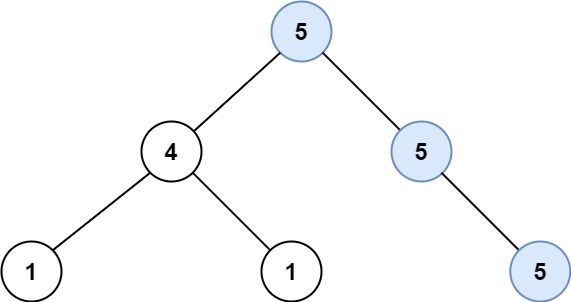
Input: root = [5,4,5,1,1,null,5]
Output: 2
Explanation: The shown image shows that the longest path of the same value (i.e. 5).
Example 2:
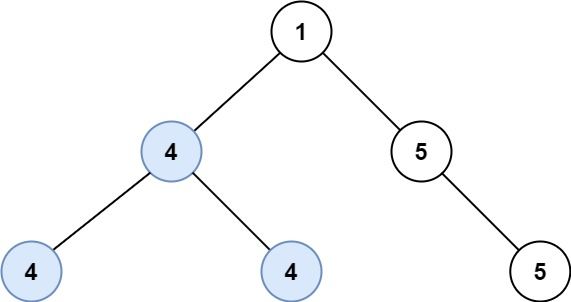
Input: root = [1,4,5,4,4,null,5]
Output: 2
Explanation: The shown image shows that the longest path of the same value (i.e. 4).
Constraints:
- The number of nodes in the tree is in the range
[0, 104].
-1000 <= Node.val <= 1000- The depth of the tree will not exceed
1000.
Solutions
Solution 1: DFS
We design a function dfs(root), which represents the longest univalue path length extending downward with the root node as one endpoint of the path.
In dfs(root), we first recursively call dfs(root.left) and dfs(root.right) to get two return values l and r. These two return values represent the longest univalue path lengths extending downward with the left and right children of the root node as one endpoint of the path, respectively.
If the root has a left child and root.val = root.left.val, then the longest univalue path length extending downward with the left child of the root as one endpoint of the path should be l + 1; otherwise, this length is 0. If the root has a right child and root.val = root.right.val, then the longest univalue path length extending downward with the right child of the root as one endpoint of the path should be r + 1; otherwise, this length is 0.
After recursively calling the left and right children, we update the answer to max(ans, l + r), which is the longest univalue path length passing through the root with the root as one endpoint of the path.
Finally, the dfs(root) function returns the longest univalue path length extending downward with the root as one endpoint of the path, which is max(l, r).
In the main function, we call dfs(root) to get the answer.
The time complexity is O(n), and the space complexity is O(n). Here, n is the number of nodes in the binary tree.
PythonJavaC++GoTypeScriptRustJavaScriptC
# Definition for a binary tree node.
# class TreeNode:
# def __init__(self, val=0, left=None, right=None):
# self.val = val
# self.left = left
# self.right = right
class Solution:
def longestUnivaluePath(self, root: Optional[TreeNode]) -> int:
def dfs(root: Optional[TreeNode]) -> int:
if root is None:
return 0
l, r = dfs(root.left), dfs(root.right)
l = l + 1 if root.left and root.left.val == root.val else 0
r = r + 1 if root.right and root.right.val == root.val else 0
nonlocal ans
ans = max(ans, l + r)
return max(l, r)
ans = 0
dfs(root)
return ans(code-box)
/**
* Definition for a binary tree node.
* public class TreeNode {
* int val;
* TreeNode left;
* TreeNode right;
* TreeNode() {}
* TreeNode(int val) { this.val = val; }
* TreeNode(int val, TreeNode left, TreeNode right) {
* this.val = val;
* this.left = left;
* this.right = right;
* }
* }
*/
class Solution {
private int ans;
public int longestUnivaluePath(TreeNode root) {
dfs(root);
return ans;
}
private int dfs(TreeNode root) {
if (root == null) {
return 0;
}
int l = dfs(root.left);
int r = dfs(root.right);
l = root.left != null && root.left.val == root.val ? l + 1 : 0;
r = root.right != null && root.right.val == root.val ? r + 1 : 0;
ans = Math.max(ans, l + r);
return Math.max(l, r);
}
}(code-box)
/**
* Definition for a binary tree node.
* struct TreeNode {
* int val;
* TreeNode *left;
* TreeNode *right;
* TreeNode() : val(0), left(nullptr), right(nullptr) {}
* TreeNode(int x) : val(x), left(nullptr), right(nullptr) {}
* TreeNode(int x, TreeNode *left, TreeNode *right) : val(x), left(left), right(right) {}
* };
*/
class Solution {
public:
int longestUnivaluePath(TreeNode* root) {
int ans = 0;
auto dfs = [&](this auto&& dfs, TreeNode* root) -> int {
if (!root) {
return 0;
}
int l = dfs(root->left);
int r = dfs(root->right);
l = root->left && root->left->val == root->val ? l + 1 : 0;
r = root->right && root->right->val == root->val ? r + 1 : 0;
ans = max(ans, l + r);
return max(l, r);
};
dfs(root);
return ans;
}
};(code-box)
/**
* Definition for a binary tree node.
* type TreeNode struct {
* Val int
* Left *TreeNode
* Right *TreeNode
* }
*/
func longestUnivaluePath(root *TreeNode) (ans int) {
var dfs func(*TreeNode) int
dfs = func(root *TreeNode) int {
if root == nil {
return 0
}
l, r := dfs(root.Left), dfs(root.Right)
if root.Left != nil && root.Left.Val == root.Val {
l++
} else {
l = 0
}
if root.Right != nil && root.Right.Val == root.Val {
r++
} else {
r = 0
}
ans = max(ans, l+r)
return max(l, r)
}
dfs(root)
return
}(code-box)
/**
* Definition for a binary tree node.
* class TreeNode {
* val: number
* left: TreeNode | null
* right: TreeNode | null
* constructor(val?: number, left?: TreeNode | null, right?: TreeNode | null) {
* this.val = (val===undefined ? 0 : val)
* this.left = (left===undefined ? null : left)
* this.right = (right===undefined ? null : right)
* }
* }
*/
function longestUnivaluePath(root: TreeNode | null): number {
let ans: number = 0;
const dfs = (root: TreeNode | null): number => {
if (!root) {
return 0;
}
let [l, r] = [dfs(root.left), dfs(root.right)];
l = root.left && root.left.val === root.val ? l + 1 : 0;
r = root.right && root.right.val === root.val ? r + 1 : 0;
ans = Math.max(ans, l + r);
return Math.max(l, r);
};
dfs(root);
return ans;
}(code-box)
// Definition for a binary tree node.
// #[derive(Debug, PartialEq, Eq)]
// pub struct TreeNode {
// pub val: i32,
// pub left: Option<Rc<RefCell<TreeNode>>>,
// pub right: Option<Rc<RefCell<TreeNode>>>,
// }
//
// impl TreeNode {
// #[inline]
// pub fn new(val: i32) -> Self {
// TreeNode {
// val,
// left: None,
// right: None
// }
// }
// }
use std::cell::RefCell;
use std::rc::Rc;
impl Solution {
fn dfs(root: &Option<Rc<RefCell<TreeNode>>>, target: i32, ans: &mut i32) -> i32 {
if root.is_none() {
return 0;
}
let root = root.as_ref().unwrap().borrow();
let left = Self::dfs(&root.left, root.val, ans);
let right = Self::dfs(&root.right, root.val, ans);
*ans = (*ans).max(left + right);
if root.val == target {
return left.max(right) + 1;
}
0
}
pub fn longest_univalue_path(root: Option<Rc<RefCell<TreeNode>>>) -> i32 {
if root.is_none() {
return 0;
}
let mut ans = 0;
Self::dfs(&root, root.as_ref().unwrap().borrow().val, &mut ans);
ans
}
}(code-box)
/**
* Definition for a binary tree node.
* function TreeNode(val, left, right) {
* this.val = (val===undefined ? 0 : val)
* this.left = (left===undefined ? null : left)
* this.right = (right===undefined ? null : right)
* }
*/
/**
* @param {TreeNode} root
* @return {number}
*/
var longestUnivaluePath = function (root) {
let ans = 0;
const dfs = root => {
if (!root) {
return 0;
}
let [l, r] = [dfs(root.left), dfs(root.right)];
l = root.left && root.left.val === root.val ? l + 1 : 0;
r = root.right && root.right.val === root.val ? r + 1 : 0;
ans = Math.max(ans, l + r);
return Math.max(l, r);
};
dfs(root);
return ans;
};(code-box)
/**
* Definition for a binary tree node.
* struct TreeNode {
* int val;
* struct TreeNode *left;
* struct TreeNode *right;
* };
*/
#define max(a, b) (((a) > (b)) ? (a) : (b))
int dfs(struct TreeNode* root, int* ans) {
if (!root) {
return 0;
}
int l = dfs(root->left, ans);
int r = dfs(root->right, ans);
l = root->left && root->left->val == root->val ? l + 1 : 0;
r = root->right && root->right->val == root->val ? r + 1 : 0;
*ans = max(*ans, l + r);
return max(l, r);
}
int longestUnivaluePath(struct TreeNode* root) {
int ans = 0;
dfs(root, &ans);
return ans;
}(code-box)


