


Description
On a single-threaded CPU, we execute a program containing n functions. Each function has a unique ID between 0 and n-1.
Function calls are stored in a call stack: when a function call starts, its ID is pushed onto the stack, and when a function call ends, its ID is popped off the stack. The function whose ID is at the top of the stack is the current function being executed. Each time a function starts or ends, we write a log with the ID, whether it started or ended, and the timestamp.
You are given a list logs, where logs[i] represents the ith log message formatted as a string "{function_id}:{"start" | "end"}:{timestamp}". For example, "0:start:3" means a function call with function ID 0 started at the beginning of timestamp 3, and "1:end:2" means a function call with function ID 1 ended at the end of timestamp 2. Note that a function can be called multiple times, possibly recursively.
A function's exclusive time is the sum of execution times for all function calls in the program. For example, if a function is called twice, one call executing for 2 time units and another call executing for 1 time unit, the exclusive time is 2 + 1 = 3.
Return the exclusive time of each function in an array, where the value at the ith index represents the exclusive time for the function with ID i.
Example 1:
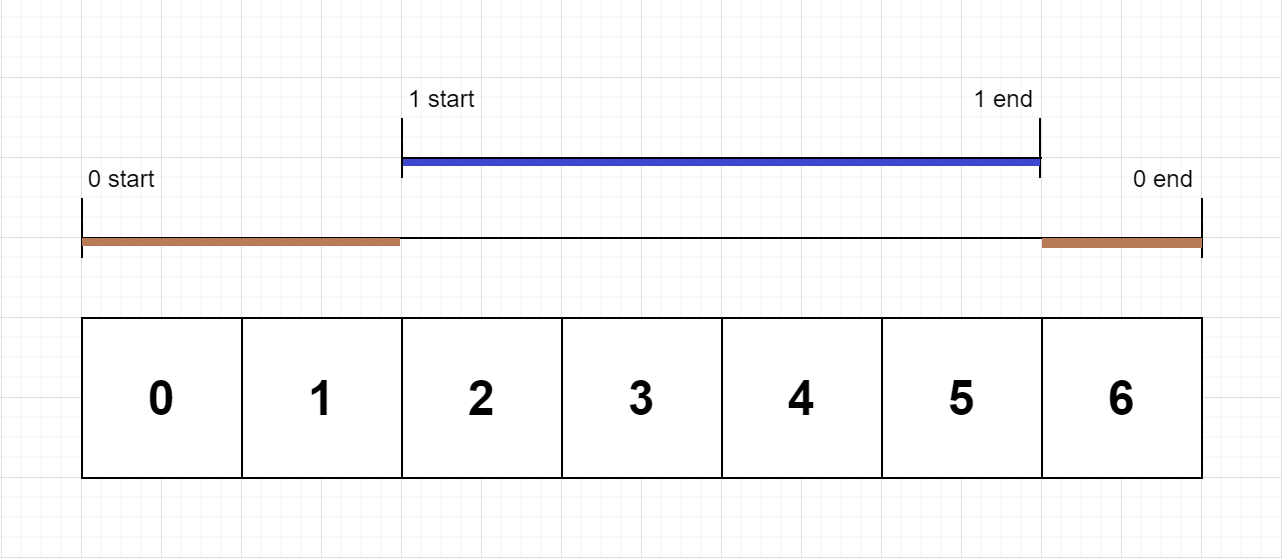
Input: n = 2, logs = ["0:start:0","1:start:2","1:end:5","0:end:6"]
Output: [3,4]
Explanation:
Function 0 starts at the beginning of time 0, then it executes 2 for units of time and reaches the end of time 1.
Function 1 starts at the beginning of time 2, executes for 4 units of time, and ends at the end of time 5.
Function 0 resumes execution at the beginning of time 6 and executes for 1 unit of time.
So function 0 spends 2 + 1 = 3 units of total time executing, and function 1 spends 4 units of total time executing.
Example 2:
Input: n = 1, logs = ["0:start:0","0:start:2","0:end:5","0:start:6","0:end:6","0:end:7"]
Output: [8]
Explanation:
Function 0 starts at the beginning of time 0, executes for 2 units of time, and recursively calls itself.
Function 0 (recursive call) starts at the beginning of time 2 and executes for 4 units of time.
Function 0 (initial call) resumes execution then immediately calls itself again.
Function 0 (2nd recursive call) starts at the beginning of time 6 and executes for 1 unit of time.
Function 0 (initial call) resumes execution at the beginning of time 7 and executes for 1 unit of time.
So function 0 spends 2 + 4 + 1 + 1 = 8 units of total time executing.
Example 3:
Input: n = 2, logs = ["0:start:0","0:start:2","0:end:5","1:start:6","1:end:6","0:end:7"]
Output: [7,1]
Explanation:
Function 0 starts at the beginning of time 0, executes for 2 units of time, and recursively calls itself.
Function 0 (recursive call) starts at the beginning of time 2 and executes for 4 units of time.
Function 0 (initial call) resumes execution then immediately calls function 1.
Function 1 starts at the beginning of time 6, executes 1 unit of time, and ends at the end of time 6.
Function 0 resumes execution at the beginning of time 6 and executes for 2 units of time.
So function 0 spends 2 + 4 + 1 = 7 units of total time executing, and function 1 spends 1 unit of total time executing.
Constraints:
1 <= n <= 1002 <= logs.length <= 5000 <= function_id < n0 <= timestamp <= 109- No two start events will happen at the same timestamp.
- No two end events will happen at the same timestamp.
- Each function has an
"end"log for each"start"log.
Solutions
Solution 1: Stack + Simulation
We define a stack stk to store the identifiers of the currently executing functions. We also define an array ans to store the exclusive time of each function, initially setting the exclusive time of each function to 0. We use a variable pre to record the previous timestamp.
We traverse the log array. For each log entry, we first split it by colons to get the function identifier i, the operation type op, and the timestamp t.
If op is start, it means function i starts executing. We need to check if the stack is empty. If it is not empty, we add cur - pre to the exclusive time of the function at the top of the stack, then push i onto the stack and update pre to cur. If op is end, it means function i finishes executing. We add cur - pre + 1 to the exclusive time of the function at the top of the stack, then pop the top element from the stack and update pre to cur + 1.
Finally, we return the array ans.
The time complexity is O(n), and the space complexity is O(n). Here, n is the length of the log array.
class Solution: def exclusiveTime(self, n: int, logs: List[str]) -> List[int]: stk = [] ans = [0] * n pre = 0 for log in logs: i, op, t = log.split(":") i, cur = int(i), int(t) if op[0] == "s": if stk: ans[stk[-1]] += cur - pre stk.append(i) pre = cur else: ans[stk.pop()] += cur - pre + 1 pre = cur + 1 return ans(code-box)
