
Description
Given a binary search tree (BST), find the lowest common ancestor (LCA) node of two given nodes in the BST.
According to the definition of LCA on Wikipedia: “The lowest common ancestor is defined between two nodes p and q as the lowest node in T that has both p and q as descendants (where we allow a node to be a descendant of itself).”
Example 1:
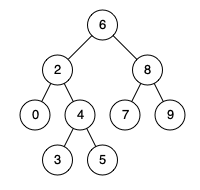
Input: root = [6,2,8,0,4,7,9,null,null,3,5], p = 2, q = 8
Output: 6
Explanation: The LCA of nodes 2 and 8 is 6.
Example 2:
Input: root = [6,2,8,0,4,7,9,null,null,3,5], p = 2, q = 4
Output: 2
Explanation: The LCA of nodes 2 and 4 is 2, since a node can be a descendant of itself according to the LCA definition.
Example 3:
Input: root = [2,1], p = 2, q = 1
Output: 2
Constraints:
- The number of nodes in the tree is in the range
[2, 105].
-109 <= Node.val <= 109- All
Node.val are unique.
p != qp and q will exist in the BST.
Solutions
Solution 1: Iteration
Starting from the root node, we traverse the tree. If the current node's value is less than both p and q values, it means that p and q should be in the right subtree of the current node, so we move to the right child. If the current node's value is greater than both p and q values, it means that p and q should be in the left subtree, so we move to the left child. Otherwise, it means the current node is the lowest common ancestor of p and q, so we return the current node.
The time complexity is O(n), where n is the number of nodes in the binary search tree. The space complexity is O(1).
PythonJavaC++GoTypeScriptC#
# Definition for a binary tree node.
# class TreeNode:
# def __init__(self, x):
# self.val = x
# self.left = None
# self.right = None
class Solution:
def lowestCommonAncestor(
self, root: 'TreeNode', p: 'TreeNode', q: 'TreeNode'
) -> 'TreeNode':
while 1:
if root.val < min(p.val, q.val):
root = root.right
elif root.val > max(p.val, q.val):
root = root.left
else:
return root(code-box)
/**
* Definition for a binary tree node.
* public class TreeNode {
* int val;
* TreeNode left;
* TreeNode right;
* TreeNode(int x) { val = x; }
* }
*/
class Solution {
public TreeNode lowestCommonAncestor(TreeNode root, TreeNode p, TreeNode q) {
while (true) {
if (root.val < Math.min(p.val, q.val)) {
root = root.right;
} else if (root.val > Math.max(p.val, q.val)) {
root = root.left;
} else {
return root;
}
}
}
}(code-box)
/**
* Definition for a binary tree node.
* struct TreeNode {
* int val;
* TreeNode *left;
* TreeNode *right;
* TreeNode(int x) : val(x), left(NULL), right(NULL) {}
* };
*/
class Solution {
public:
TreeNode* lowestCommonAncestor(TreeNode* root, TreeNode* p, TreeNode* q) {
while (1) {
if (root->val < min(p->val, q->val)) {
root = root->right;
} else if (root->val > max(p->val, q->val)) {
root = root->left;
} else {
return root;
}
}
}
};(code-box)
/**
* Definition for a binary tree node.
* type TreeNode struct {
* Val int
* Left *TreeNode
* Right *TreeNode
* }
*/
func lowestCommonAncestor(root, p, q *TreeNode) *TreeNode {
for {
if root.Val < min(p.Val, q.Val) {
root = root.Right
} else if root.Val > max(p.Val, q.Val) {
root = root.Left
} else {
return root
}
}
}(code-box)
/**
* Definition for a binary tree node.
* class TreeNode {
* val: number
* left: TreeNode | null
* right: TreeNode | null
* constructor(val?: number, left?: TreeNode | null, right?: TreeNode | null) {
* this.val = (val===undefined ? 0 : val)
* this.left = (left===undefined ? null : left)
* this.right = (right===undefined ? null : right)
* }
* }
*/
function lowestCommonAncestor(
root: TreeNode | null,
p: TreeNode | null,
q: TreeNode | null,
): TreeNode | null {
while (root) {
if (root.val > p.val && root.val > q.val) {
root = root.left;
} else if (root.val < p.val && root.val < q.val) {
root = root.right;
} else {
return root;
}
}
}(code-box)
/**
* Definition for a binary tree node.
* public class TreeNode {
* public int val;
* public TreeNode left;
* public TreeNode right;
* public TreeNode(int x) { val = x; }
* }
*/
public class Solution {
public TreeNode LowestCommonAncestor(TreeNode root, TreeNode p, TreeNode q) {
while (true) {
if (root.val < Math.Min(p.val, q.val)) {
root = root.right;
} else if (root.val > Math.Max(p.val, q.val)) {
root = root.left;
} else {
return root;
}
}
}
}(code-box)
Solution 2: Recursion
We can also use a recursive approach to solve this problem.
We first check if the current node's value is less than both p and q values. If it is, we recursively traverse the right subtree. If the current node's value is greater than both p and q values, we recursively traverse the left subtree. Otherwise, it means the current node is the lowest common ancestor of p and q, so we return the current node.
The time complexity is O(n), and the space complexity is O(n). Where n is the number of nodes in the binary search tree.
PythonJavaC++GoTypeScriptC#
# Definition for a binary tree node.
# class TreeNode:
# def __init__(self, x):
# self.val = x
# self.left = None
# self.right = None
class Solution:
def lowestCommonAncestor(
self, root: 'TreeNode', p: 'TreeNode', q: 'TreeNode'
) -> 'TreeNode':
if root.val < min(p.val, q.val):
return self.lowestCommonAncestor(root.right, p, q)
if root.val > max(p.val, q.val):
return self.lowestCommonAncestor(root.left, p, q)
return root(code-box)
/**
* Definition for a binary tree node.
* public class TreeNode {
* int val;
* TreeNode left;
* TreeNode right;
* TreeNode(int x) { val = x; }
* }
*/
class Solution {
public TreeNode lowestCommonAncestor(TreeNode root, TreeNode p, TreeNode q) {
if (root.val < Math.min(p.val, q.val)) {
return lowestCommonAncestor(root.right, p, q);
}
if (root.val > Math.max(p.val, q.val)) {
return lowestCommonAncestor(root.left, p, q);
}
return root;
}
}(code-box)
/**
* Definition for a binary tree node.
* struct TreeNode {
* int val;
* TreeNode *left;
* TreeNode *right;
* TreeNode(int x) : val(x), left(NULL), right(NULL) {}
* };
*/
class Solution {
public:
TreeNode* lowestCommonAncestor(TreeNode* root, TreeNode* p, TreeNode* q) {
if (root->val < min(p->val, q->val)) {
return lowestCommonAncestor(root->right, p, q);
}
if (root->val > max(p->val, q->val)) {
return lowestCommonAncestor(root->left, p, q);
}
return root;
}
};(code-box)
/**
* Definition for a binary tree node.
* type TreeNode struct {
* Val int
* Left *TreeNode
* Right *TreeNode
* }
*/
func lowestCommonAncestor(root, p, q *TreeNode) *TreeNode {
if root.Val < p.Val && root.Val < q.Val {
return lowestCommonAncestor(root.Right, p, q)
}
if root.Val > p.Val && root.Val > q.Val {
return lowestCommonAncestor(root.Left, p, q)
}
return root
}(code-box)
/**
* Definition for a binary tree node.
* class TreeNode {
* val: number
* left: TreeNode | null
* right: TreeNode | null
* constructor(val?: number, left?: TreeNode | null, right?: TreeNode | null) {
* this.val = (val===undefined ? 0 : val)
* this.left = (left===undefined ? null : left)
* this.right = (right===undefined ? null : right)
* }
* }
*/
function lowestCommonAncestor(
root: TreeNode | null,
p: TreeNode | null,
q: TreeNode | null,
): TreeNode | null {
if (root.val > p.val && root.val > q.val) {
return lowestCommonAncestor(root.left, p, q);
}
if (root.val < p.val && root.val < q.val) {
return lowestCommonAncestor(root.right, p, q);
}
return root;
}(code-box)
/**
* Definition for a binary tree node.
* public class TreeNode {
* public int val;
* public TreeNode left;
* public TreeNode right;
* public TreeNode(int x) { val = x; }
* }
*/
public class Solution {
public TreeNode LowestCommonAncestor(TreeNode root, TreeNode p, TreeNode q) {
if (root.val < Math.Min(p.val, q.val)) {
return LowestCommonAncestor(root.right, p, q);
}
if (root.val > Math.Max(p.val, q.val)) {
return LowestCommonAncestor(root.left, p, q);
}
return root;
}
}(code-box)


