
Description
Given the root of a complete binary tree, return the number of the nodes in the tree.
According to Wikipedia, every level, except possibly the last, is completely filled in a complete binary tree, and all nodes in the last level are as far left as possible. It can have between 1 and 2h nodes inclusive at the last level h.
Design an algorithm that runs in less than O(n) time complexity.
Example 1:
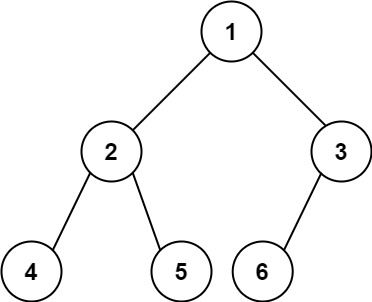
Input: root = [1,2,3,4,5,6]
Output: 6
Example 2:
Input: root = []
Output: 0
Example 3:
Input: root = [1]
Output: 1
Constraints:
- The number of nodes in the tree is in the range
[0, 5 * 104].
0 <= Node.val <= 5 * 104- The tree is guaranteed to be complete.
Solutions
Solution 1: Recursion
We recursively traverse the entire tree and count the number of nodes.
The time complexity is O(n), and the space complexity is O(n), where n is the number of nodes in the tree.
PythonJavaC++GoRustJavaScriptC#
# Definition for a binary tree node.
# class TreeNode:
# def __init__(self, val=0, left=None, right=None):
# self.val = val
# self.left = left
# self.right = right
class Solution:
def countNodes(self, root: Optional[TreeNode]) -> int:
if root is None:
return 0
return 1 + self.countNodes(root.left) + self.countNodes(root.right)(code-box)
/**
* Definition for a binary tree node.
* public class TreeNode {
* int val;
* TreeNode left;
* TreeNode right;
* TreeNode() {}
* TreeNode(int val) { this.val = val; }
* TreeNode(int val, TreeNode left, TreeNode right) {
* this.val = val;
* this.left = left;
* this.right = right;
* }
* }
*/
class Solution {
public int countNodes(TreeNode root) {
if (root == null) {
return 0;
}
return 1 + countNodes(root.left) + countNodes(root.right);
}
}(code-box)
/**
* Definition for a binary tree node.
* struct TreeNode {
* int val;
* TreeNode *left;
* TreeNode *right;
* TreeNode() : val(0), left(nullptr), right(nullptr) {}
* TreeNode(int x) : val(x), left(nullptr), right(nullptr) {}
* TreeNode(int x, TreeNode *left, TreeNode *right) : val(x), left(left), right(right) {}
* };
*/
class Solution {
public:
int countNodes(TreeNode* root) {
if (!root) {
return 0;
}
return 1 + countNodes(root->left) + countNodes(root->right);
}
};(code-box)
/**
* Definition for a binary tree node.
* type TreeNode struct {
* Val int
* Left *TreeNode
* Right *TreeNode
* }
*/
func countNodes(root *TreeNode) int {
if root == nil {
return 0
}
return 1 + countNodes(root.Left) + countNodes(root.Right)
}(code-box)
use std::cell::RefCell;
use std::rc::Rc;
impl Solution {
pub fn count_nodes(root: Option<Rc<RefCell<TreeNode>>>) -> i32 {
if let Some(node) = root {
let node = node.borrow();
let left = Self::depth(&node.left);
let right = Self::depth(&node.right);
if left == right {
Self::count_nodes(node.right.clone()) + (1 << left)
} else {
Self::count_nodes(node.left.clone()) + (1 << right)
}
} else {
0
}
}
fn depth(root: &Option<Rc<RefCell<TreeNode>>>) -> i32 {
if let Some(node) = root {
Self::depth(&node.borrow().left) + 1
} else {
0
}
}
}(code-box)
/**
* Definition for a binary tree node.
* function TreeNode(val, left, right) {
* this.val = (val===undefined ? 0 : val)
* this.left = (left===undefined ? null : left)
* this.right = (right===undefined ? null : right)
* }
*/
/**
* @param {TreeNode} root
* @return {number}
*/
var countNodes = function (root) {
if (!root) {
return 0;
}
return 1 + countNodes(root.left) + countNodes(root.right);
};(code-box)
/**
* Definition for a binary tree node.
* public class TreeNode {
* public int val;
* public TreeNode left;
* public TreeNode right;
* public TreeNode(int val=0, TreeNode left=null, TreeNode right=null) {
* this.val = val;
* this.left = left;
* this.right = right;
* }
* }
*/
public class Solution {
public int CountNodes(TreeNode root) {
if (root == null) {
return 0;
}
return 1 + CountNodes(root.left) + CountNodes(root.right);
}
}(code-box)
Solution 2: Binary Search
For this problem, we can also take advantage of the characteristics of a complete binary tree to design a faster algorithm.
Characteristics of a complete binary tree: leaf nodes can only appear on the bottom and second-to-bottom layers, and the leaf nodes on the bottom layer are concentrated on the left side of the tree. It should be noted that a full binary tree is definitely a complete binary tree, but a complete binary tree is not necessarily a full binary tree.
If the number of layers in a full binary tree is h, then the total number of nodes is 2^h - 1.
We first count the heights of the left and right subtrees of root, denoted as left and right.
- If left = right, it means that the left subtree is a full binary tree, so the total number of nodes in the left subtree is 2^{left} - 1. Plus the root node, it is 2^{left}. Then we recursively count the right subtree.
- If left > right, it means that the right subtree is a full binary tree, so the total number of nodes in the right subtree is 2^{right} - 1. Plus the root node, it is 2^{right}. Then we recursively count the left subtree.
The time complexity is O(log^2 n).
PythonJavaC++GoJavaScriptC#
# Definition for a binary tree node.
# class TreeNode:
# def __init__(self, val=0, left=None, right=None):
# self.val = val
# self.left = left
# self.right = right
class Solution:
def countNodes(self, root: Optional[TreeNode]) -> int:
def depth(root):
d = 0
while root:
d += 1
root = root.left
return d
if root is None:
return 0
left, right = depth(root.left), depth(root.right)
if left == right:
return (1 << left) + self.countNodes(root.right)
return (1 << right) + self.countNodes(root.left)(code-box)
/**
* Definition for a binary tree node.
* public class TreeNode {
* int val;
* TreeNode left;
* TreeNode right;
* TreeNode() {}
* TreeNode(int val) { this.val = val; }
* TreeNode(int val, TreeNode left, TreeNode right) {
* this.val = val;
* this.left = left;
* this.right = right;
* }
* }
*/
class Solution {
public int countNodes(TreeNode root) {
if (root == null) {
return 0;
}
int left = depth(root.left);
int right = depth(root.right);
if (left == right) {
return (1 << left) + countNodes(root.right);
}
return (1 << right) + countNodes(root.left);
}
private int depth(TreeNode root) {
int d = 0;
for (; root != null; root = root.left) {
++d;
}
return d;
}
}(code-box)
/**
* Definition for a binary tree node.
* struct TreeNode {
* int val;
* TreeNode *left;
* TreeNode *right;
* TreeNode() : val(0), left(nullptr), right(nullptr) {}
* TreeNode(int x) : val(x), left(nullptr), right(nullptr) {}
* TreeNode(int x, TreeNode *left, TreeNode *right) : val(x), left(left), right(right) {}
* };
*/
class Solution {
public:
int countNodes(TreeNode* root) {
if (!root) {
return 0;
}
int left = depth(root->left);
int right = depth(root->right);
if (left == right) {
return (1 << left) + countNodes(root->right);
}
return (1 << right) + countNodes(root->left);
}
int depth(TreeNode* root) {
int d = 0;
for (; root; root = root->left) {
++d;
}
return d;
}
};(code-box)
/**
* Definition for a binary tree node.
* type TreeNode struct {
* Val int
* Left *TreeNode
* Right *TreeNode
* }
*/
func countNodes(root *TreeNode) int {
if root == nil {
return 0
}
left, right := depth(root.Left), depth(root.Right)
if left == right {
return (1 << left) + countNodes(root.Right)
}
return (1 << right) + countNodes(root.Left)
}
func depth(root *TreeNode) (d int) {
for ; root != nil; root = root.Left {
d++
}
return
}(code-box)
/**
* Definition for a binary tree node.
* function TreeNode(val, left, right) {
* this.val = (val===undefined ? 0 : val)
* this.left = (left===undefined ? null : left)
* this.right = (right===undefined ? null : right)
* }
*/
/**
* @param {TreeNode} root
* @return {number}
*/
var countNodes = function (root) {
const depth = root => {
let d = 0;
for (; root; root = root.left) {
++d;
}
return d;
};
if (!root) {
return 0;
}
const left = depth(root.left);
const right = depth(root.right);
if (left == right) {
return (1 << left) + countNodes(root.right);
}
return (1 << right) + countNodes(root.left);
};(code-box)
/**
* Definition for a binary tree node.
* public class TreeNode {
* public int val;
* public TreeNode left;
* public TreeNode right;
* public TreeNode(int val=0, TreeNode left=null, TreeNode right=null) {
* this.val = val;
* this.left = left;
* this.right = right;
* }
* }
*/
public class Solution {
public int CountNodes(TreeNode root) {
if (root == null) {
return 0;
}
int left = depth(root.left);
int right = depth(root.right);
if (left == right) {
return (1 << left) + CountNodes(root.right);
}
return (1 << right) + CountNodes(root.left);
}
private int depth(TreeNode root) {
int d = 0;
for (; root != null; root = root.left) {
++d;
}
return d;
}
}(code-box)


